
5 Things Every Good Explainer Video Must Have
SBN MEDIA TEAM
3/23/20269 min read
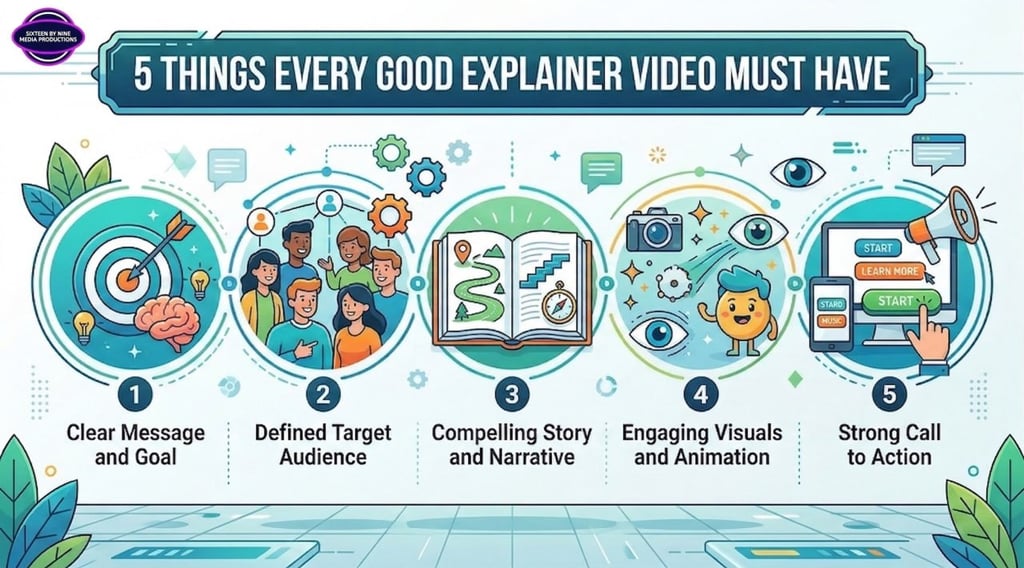
Explainer videos are among the most requested content formats across industries. Brands use them to introduce products, simplify complex services, onboard new customers, and communicate value propositions quickly. The best explainer videos go further. They drive genuine understanding and move audiences toward action.
Over years of producing explainer videos for clients across healthcare, fintech, manufacturing, and consumer brands, we at Sixteen By Nine (SBN) Media have built deep creative expertise in crafting videos that genuinely serve business objectives, videos that perform, convert, and earn their place on a landing page.
What Is the Real Purpose of an Explainer Video?
An explainer video is not a product brochure in motion. It is not a feature walkthrough, a brand film, or a company overview. Its singular purpose is to close the gap between what your audience currently understands and what they need to understand in order to take the next step, whether that is making a purchase, signing up for a trial, requesting a demo, or simply forming a clear picture of your offering.
This distinction matters because the moment a production team loses sight of this purpose, every creative decision that follows starts drifting in the wrong direction.
With that framing in place, here are the five elements every good explainer video must have.
1. A Single, Focused Core Message
Why this is the most common area where explainer videos lose their effectiveness
The most frequent challenge we encounter when a client brings us an explainer video brief is scope. The brief contains six objectives, nine key messages, and a request to cover every feature of a product in under two minutes. This is understandable. When a team has worked hard on a product, every aspect feels important, and handing a video brief to a production company feels like an opportunity to communicate everything at once.
The result, however, is a video that says many things clearly and nothing memorable.
A good explainer video is built around one core message. Not one topic, not one department's priority, but one central idea that the viewer walks away with. Every other element of the video, including the visuals, the script, the pacing, and the examples, should serve that one idea.
How to identify your core message
Ask this question: If a viewer remembers only one thing from this video, what should that one thing be?
The answer to that question is your core message. It should be a statement, not a list. "Our platform reduces manual data entry by 80% for finance teams" is a core message. "Our platform is fast, accurate, intelligent, and easy to use" is a marketing slogan, not a core message, and it will not anchor an effective explainer video.
At SBN Media, our pre-production process always includes a message alignment session before a single line of script is written. This session is specifically designed to work through the competing priorities in a brief and arrive at the one idea that the video will be built around.
2. A Narrative Structure That Earns Attention
Why storytelling is not optional in explainer videos
There is a common assumption that explainer videos follow a fixed structure: open with the problem, introduce the solution, list the features, close with a call to action. This is a functional template, and it produces functional videos. But functional is not the same as effective.
The explainer videos that consistently hold viewer attention and drive action share one structural quality: they use narrative tension. They do not just describe a problem. They make the viewer feel the weight of that problem before they introduce the solution.
A narrative structure does not mean dramatising or over-stating. It means building a logical and emotional arc that moves the viewer from one state to another. That arc has three movements:
Tension creates the reason to keep watching. It establishes that there is a gap between where the viewer is and where they want to be. This should be specific and recognisable. Generic pain points do not create tension. Specific, accurately described situations do.
Resolution introduces the solution in a way that connects directly to the tension. The most effective explainer videos do not say "introducing our product." They show the viewer what their world looks like when the problem is resolved.
Confidence closes the narrative loop. This is where proof elements, case studies, specific results, or trust signals appear. The viewer has seen the tension and the resolution. Confidence gives them the reassurance they need to act.
3. Visual Language That Reinforces the Message
The role of visual design in comprehension and retention
Explainer videos come in several formats: live-action, 2D animation, 3D animation, motion graphics, and hybrid combinations of these. Clients often have strong preferences about format before the production conversation begins. Those preferences are worth discussing, but they should not drive the creative decision.
The right visual language for an explainer video is the one that most efficiently communicates the core message to the target audience. That is the only criterion that matters.
Here is how each format performs in specific contexts:
2D animation is well-suited to abstract concepts, software products, and service-based offerings where there is no physical product to show. It allows complete creative control over the visual environment and is cost-effective at a high quality level.
Motion graphics and data visualisation work exceptionally well for explainer videos that need to communicate numbers, processes, or comparisons. When a statistic needs to land, a well-designed motion graphic will outperform a presenter reading from a script every time.
Live-action brings credibility and emotional warmth. It works best when the human element of the product or service is central to the message. A healthcare brand, a recruitment platform, or a service that relies on human expertise are natural candidates for live-action.
Hybrid formats combine the emotional resonance of live-action with the explanatory power of animation or motion graphics. Many of the most effective explainer videos we have produced at SBN Media use this approach because it allows each element of the message to be communicated in its most effective visual mode.
The visual design also carries a brand responsibility. Every frame is communicating something about who the brand is. Consistency in colour, typography, illustration style, and motion language is not a cosmetic consideration. It is a credibility signal.
4. Audio That Matches the Standard of the Visuals
Why audio quality is the element viewers notice most when it falls short
Audio is consistently underestimated in explainer video production planning. It receives less attention in briefs, smaller allocations in budgets, and fewer revision cycles in post-production. And yet, poor audio quality is the single fastest way to lose viewer trust.
Research on video consumption supports this consistently. Viewers tolerate average visual quality more readily than they tolerate poor audio. An explainer video with crisp, clear audio and competent visuals performs better than one with exceptional visuals and poor audio.
Good audio in an explainer video has three components:
Voiceover quality and casting are critical. The voice carries the script, and the script carries the message. A voiceover artist who is technically proficient but tonally mismatched to the brand will undermine even a strong script. At SBN Media, we treat voiceover casting as seriously as we treat any other creative decision. We present clients with options and guide them toward the voice that best represents how their brand should sound, not just what their brand says.
Music and sound design shape the emotional tone of the video more powerfully than most clients expect. Music cues the viewer on how to feel about what they are seeing. An upbeat track communicates energy and confidence. A more considered, minimal score communicates precision and sophistication. The wrong choice does not just feel off. It actively works against the message.
Mixing and mastering ensure that every audio element sits correctly in relation to the others. The voiceover should be clear above the music. Sound design should complement without competing. This is post-production work that is invisible when done well and immediately obvious when it is overlooked.
5. A Clear, Specific Call to Action
Why the call to action deserves as much creative thought as the opening hook
The call to action is where an explainer video either earns its investment or leaves it unrealised. It is the moment of conversion, the point where a viewer who understands your offering is invited to take a step toward it. And it is consistently the most underwritten element of the explainer videos we review.
The most common version of a weak call to action is a closing slide that says "Contact Us Today" or "Learn More." These phrases tell a viewer nothing specific. They do not connect back to the core message. They do not carry forward the emotional tone of the video. They ask a viewer who has just been taken on a journey to do something entirely generic at the end of it.
A strong call to action has three qualities:
Specificity means the viewer knows exactly what will happen when they take the step. "Book a free 20-minute demo" is specific. "Get in touch" is not.
Continuity means the call to action connects logically and emotionally to the rest of the video. If the video has built tension around a specific problem and resolved it with a specific solution, the call to action should be the natural next step in that narrative. "See how this works for your business" continues the story. "Visit our website" ends it abruptly.
Placement matters more than most clients realise. The call to action typically appears at the end of an explainer video, and this is often the right placement. But in longer formats, a softer call to action mid-video can significantly improve overall conversion rates by catching viewers who are already convinced before the video concludes.
How These Five Elements Work Together
These five elements are not a checklist of independent tasks. They are an integrated system. A focused core message shapes the narrative structure. The narrative structure dictates the visual language. The visual language determines the audio requirements. And all four of these elements serve the call to action.
When one element is weak, the others cannot fully compensate. A strong narrative with unfocused core messaging produces a video that is enjoyable to watch but not particularly motivating to act on. Excellent audio and visuals with a generic call to action produce a video that impresses without converting.
The explainer videos that consistently perform well, across industries, formats, and budgets, are the ones where all five elements have been deliberately considered and carefully aligned.
What to Look for When Commissioning an Explainer Video
If you are working with a production company on an explainer video, the pre-production process is where these five elements are either built in or left out. Here is what to look for:
Does the team ask about your business objectives before discussing visual style?
Is there a dedicated message strategy session or script development stage?
Does the team present a narrative rationale for the script, not just the script itself?
Are visual and audio decisions explained in terms of the message, not just aesthetic preference?
Is the call to action discussed as a strategic element with specific wording and placement?
A production team that takes these questions seriously is building your explainer video on solid foundations. One that moves directly to style references and animation samples without addressing strategy is building on something much less reliable.
Have a look at the Explainer Videos Made by SBN Media
1. Waaree Radiance Solar Kit B2C Campaign
Industry: Solar
Watch the Solar B2C Campaign video
2. Waaree Battery Energy Storage Solutions (BESS)
Industry: Solar
4. OneAssist Appliance Protection Campaign
Industry: Insurance
Watch the TV Protection Plan Ad Film
Watch the Accidental & Liquid damage Laptop plan Ad Film
Watch the Washing Machine Extended Warranty Ad film
5. Harkesh Rubber Cryogenic Deflashing Showcase
Industry: Rubber Parts Manufacturing
Watch the Cryogenic Deflashing showcase video
Frequently Asked Questions
How long should an explainer video be?
For most use cases, 60 to 90 seconds is the effective range. Complex B2B products may extend to two to three minutes, but every additional second requires a justification rooted in the message, not the content volume.
Can a good explainer video be produced with a limited budget?
Yes. A limited budget should be applied to a tighter scope: shorter duration, simpler visual style, and a more focused message. The five essential elements outlined in this article apply regardless of budget size.
Should we update an existing explainer video or produce a new one?
If the core message and product have changed significantly, a new video is a more effective investment. If the message is intact but the visual style feels dated, a partial refresh of the motion design and audio may be sufficient.
How does SBN Media approach explainer video projects?
We begin with a strategic brief session to align on the core message and business objective. From there, we develop the script and narrative arc before any visual development begins. This sequence is deliberate. It ensures that every creative decision serves the message rather than existing alongside it.
Conclusion
A great explainer video is not the result of good execution alone. It is the result of good thinking applied before a single frame is shot or animated. When the core message is sharp, the narrative earns attention, the visuals serve the story, the audio holds the standard, and the call to action gives the viewer a clear next step, the video does exactly what it was built to do.
At SBN Media, we produce explainer videos for brands across healthcare, fintech, manufacturing, and consumer products, working across 2D animation, live-action, motion graphics, and hybrid formats. Every project begins the same way: with a conversation about your objectives, not your visual preferences.
If you are planning an explainer video, start with a strategy conversation with the SBN Media team before you commit to a single creative decision.
© Sixteen By NIne Media 2024. All rights reserved.
SBN Media | AI Video Studio & Corporate Film Production – Mumbai, India
Specialized in AI-powered corporate videos, brand films, product ads, and multilingual content