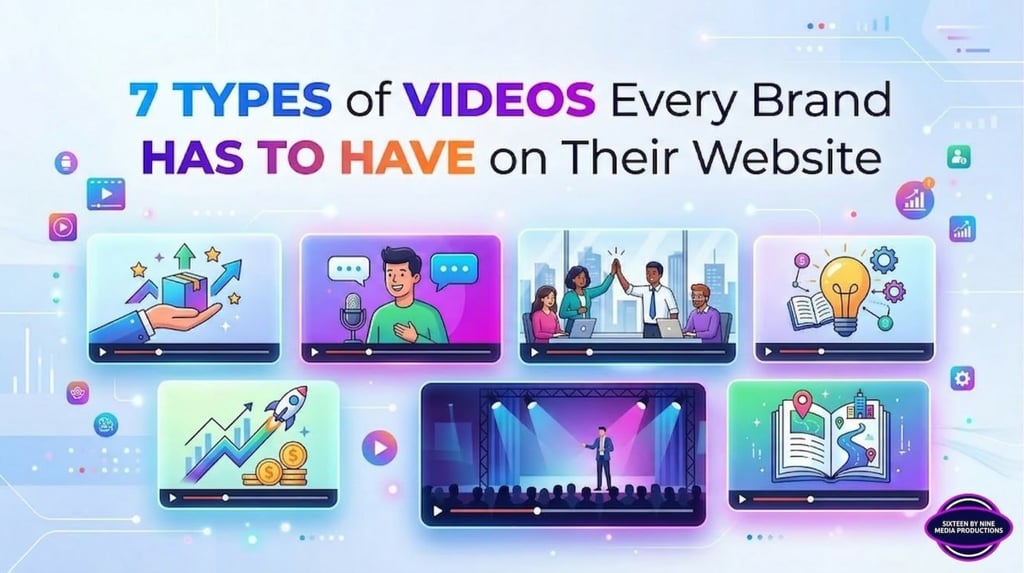
7 Types of Videos Every Brand HAS to Have on Their Website
Essential videos that make your website work
SBN MEDIA TEAM
3/18/20268 min read
Your website is doing a job around the clock. It is talking to prospects, introducing your company to strangers, and trying to hold someone's attention long enough to convert them into a customer. The problem is that most websites rely almost entirely on text and static images to do that job. And text alone is slow. It asks a lot from the reader.
Video changes that equation entirely. A well-placed video communicates tone, builds trust, and moves people forward in ways that a block of copy simply cannot. But here is where most brands go wrong: they add one video somewhere on the website and call it done. One brand film on the homepage, one product demo buried three pages deep, and nothing else.
That is not a video strategy. That is a checkbox.
A website that converts and builds brand equity needs more than one video. It needs the right types of videos, placed in the right places, each doing a specific job. Here are seven types of videos that belong on every serious brand's website.
1. The Brand Film
This is the video that answers the question every first-time visitor is silently asking: Who are you, really?
A brand film is not a product explainer. It is not a company timeline. It is the emotional and philosophical centre of your brand, told in a way that makes someone feel something. It communicates values, vision, and personality in under two to three minutes. Done well, it makes a stranger feel like they already know your brand.
This video belongs on your homepage, above the fold or very close to it. It is often the first impression a prospect gets of your company, which means it carries enormous weight. A grainy, generic, template-driven video here will do more harm than good. Conversely, a cinematic, confident brand film instantly signals that this is a company worth paying attention to.
What does a brand film actually contain? It depends on the brand. For a manufacturing company, it might be wide shots of a production floor, workers in motion, precision machinery, and a voiceover that speaks to decades of craft. For a consumer startup, it might be fast-cut lifestyle footage with a punchy script and a strong point of view. The format follows the brand. What is non-negotiable is that the film has a perspective. It is not neutral. It stands for something.
At Sixteen By Nine Media, we have built brand films for companies across manufacturing, infrastructure, and industrial sectors. The brief is always the same: make the audience feel proud to do business with this company. That feeling is what a great brand film delivers.
Explore Brand Films Made By SBN Media
Watch the BirlaNu CoverMax Putty Ad
Watch the Zydus Healthcare: The Easiest Exam Breast Cancer Awareness Film
2. The Product or Service Explainer
Once someone knows who you are, they want to know what you do. Not in theory. In specifics.
The explainer video is where you bridge the gap between interest and intent. It answers the questions your sales team gets asked on every call, distilled into a focused, well-paced video. What does your product do? Who is it for? What problem does it solve? What makes it different?
Explainers work across almost every category. SaaS products use them to demonstrate the software without needing a live demo. Industrial brands use them to explain complex manufacturing processes or technical specifications. Service companies use them to walk potential clients through how the engagement works, removing ambiguity and reducing friction.
The keyword here is clarity. An explainer video that is visually beautiful but confusing is a wasted asset. Viewers should be able to watch once and immediately understand what you are offering and whether it is relevant to them. That clarity creates a natural filter: the wrong prospects self-select out, and the right prospects move forward with intent.
Explainers live most naturally on product pages, service pages, and landing pages. They can also be powerful in email campaigns, where a quick video linked in the body of an outreach significantly lifts click-through rates.
Animation works exceptionally well in this format. It allows you to visualise things that cannot be filmed, simplify complex ideas, and maintain a consistent brand aesthetic without being constrained by production logistics. For brands with abstract or technical offerings, an animated explainer is often the single highest-ROI video on the site.
Explore Explainer Videos Made by SBN Media
Watch the OneAssist Malayalam animated explainer
3. Process and Behind-the-Scenes Video
Claims are easy to make. Proof is harder to fake.
A behind-the-scenes or process video takes the viewer inside your operation and shows them how the work actually gets done. For manufacturing brands, that means the production floor, quality control checkpoints, raw material sourcing, and the hands building the finished product. For service businesses, it means showing the thinking, the workflow, and the team in action.
This type of video does something that no case study or brochure can: it makes the invisible visible. Buyers who have never seen your facility, met your team, or watched your process in motion are essentially taking your word for everything. A well-shot process video removes that leap of faith. It transforms abstract claims like "precision engineering" or "quality at every step" into something the viewer can actually see and believe.
Behind-the-scenes content also humanizes the brand. It shows real people doing real work with real care. In categories where vendors often feel interchangeable on paper, this kind of transparency is a genuine differentiator. Brands that are willing to open the door and show their process signal confidence. They are not hiding anything. That confidence is contagious.
Explore Process Videos Made by SBN Media
Watch the Waaree RTL | ACCIONA Energía Project Showcase
4. Product Demo Video
An explainer tells someone what your product does. A demo shows it happening.
These are two different things, and they serve two different stages of the buyer's journey. A prospect who is already sold on the category and is now evaluating specific vendors does not need another overview. They need to see the product perform. They want to watch it in real conditions, doing the exact thing they need it to do, and producing the kind of result they are hoping for.
For technical products, machinery, industrial equipment, software platforms, or anything where performance is the core claim, a demo video is often the deciding factor. It removes the "I'll believe it when I see it" barrier that even the most persuasive sales conversation struggles to overcome.
A strong demo video is specific, not generic. It focuses on the use case most relevant to the target buyer, shows the product under realistic conditions, and calls out the details that matter. Running time, output quality, ease of operation, tolerances, and integrations, among others. Whatever the buyer's actual evaluation criteria are, those are what the demo highlights.
Demo videos belong on product pages, in sales decks, and in follow-up sequences after a discovery call. They are some of the most functional and direct-response assets in a brand's video library.
Explore Product Demo Videos Made by SBN Media
Watch the Harpic Complete Clean Campaign
5. Company Culture and Recruitment Video
Your website is not just talking to customers. It is also talking to people who might want to work for you.
As companies grow and compete for strong talent, the culture video has moved from a nice-to-have to a serious strategic asset. A well-made culture video shows what it is actually like to work at the company. The people, the environment, the kind of problems the team works on, and the values that show up in everyday decisions. It gives a candidate a genuine sense of fit before they ever apply.
The most common mistake brands make with culture videos is turning them into recruitment propaganda. A video full of sweeping office shots, branded hoodies, and employees saying things like "we are like a family here" tells a candidate almost nothing. What works is specificity. Real employees talking about real projects. A glimpse into how decisions get made. Honest language about what the work is actually like and what kind of person thrives here.
A strong culture video attracts the right candidates and filters out the wrong ones. That is valuable in both directions. The cost of a bad hire is high. A culture video that accurately represents the environment saves everyone time.
For growing companies and startups where talent is a genuine competitive advantage, this video deserves the same production investment and strategic thinking as any customer-facing asset.
Explore the Company Culture Videos Made by SBN Media
Watch the Asian Paints Corporate Anthem Music Video
6. Event and Launch Recap Video
Things happen at great companies. Products get launched. Milestones get reached. Teams show up at industry events and make an impression. A recap video captures those moments and puts them on the website as evidence that this brand is active, growing, and worth following.
There is a subtler benefit here that often goes unnoticed. A website without any time-sensitive content can feel static, even if the underlying business is thriving. Event and launch recap videos give the site a sense of momentum. They signal that the brand is in motion. For prospects doing research before a purchase decision, that sense of activity matters. It is one of the signals they use to distinguish a brand that is growing from one that has stagnated.
Recap videos are also highly repurposable. A well-edited three-minute recap of a product launch event can be cut into shorter social clips, used in investor updates, shared with partners, and embedded in post-event emails. The website version becomes the anchor, and everything else distributes from it.
They do not require elaborate production budgets. A focused shoot on the day, a tight edit, and a clear narrative arc around what happened and why it mattered is enough. The goal is not cinematic ambition. It is documented momentum.
Explore Event Videos Made by SBN Media
Watch the Retail Jewellers Award - Mumbai
7. CSR and Impact Video
Increasingly, buyers, partners, investors, and employees want to know what a brand stands for beyond the transaction.
A CSR or impact video tells that story. It documents the company's work in sustainability, community investment, environmental responsibility, or social impact. It shows the values in action, not just listed on a webpage. For brands that genuinely have a story to tell here, this video is one of the most powerful trust-building assets on the site.
The keyword is genuinely. A CSR video built around thin or performative initiatives tends to backfire. Audiences have a well-calibrated radar for purpose-washing, and a video that does not hold up to scrutiny does real reputational damage. But a brand that has made meaningful commitments and can show real outcomes has a story worth telling, and a video is the most compelling format to tell it in.
For manufacturing and industrial brands in particular, this type of content is increasingly relevant. Enterprise buyers often have their own ESG reporting requirements and prefer vendors who can demonstrate alignment. A strong impact video can be a direct input into procurement decisions, not just a brand image asset.
Explore CSR and Impact Videos Made by SBN Media
Watch the Humans of Zomato Video
Putting It All Together
Each of these seven video types has a distinct role on your website. Together they cover every stage of the buyer's journey, from the first emotional impression right through to the final decision. The brand film builds a connection. The explainer creates clarity around your offering. The process video shows the work behind the claims. The demo removes the last wall of doubt for a prospect on the verge of deciding. The culture video attracts the right people to your team. Recap videos signal that the brand is in motion. And the CSR video anchors everything in values that go beyond the transaction.
You do not have to produce all seven at once. A phased approach works well. Start with the brand film and a core explainer. Add the process and demo videos as your sales conversations mature. Build the culture video when talent becomes a priority. Layer in recap and CSR content as the brand grows and the stories accumulate.
The brands that invest consistently in the right types of videos, rather than treating video as a one-time project, consistently outperform those that do not. In a market where attention is scarce and trust is earned in seconds, your website video library is one of the most leverageable brand assets you can build.
If you want to understand which of these videos would move the needle fastest for your business, that is exactly the kind of conversation we have with brands every day at SBN Media.
SBN Media is an AI-powered video production company helping brands tell their stories with precision and purpose. From brand films to animated explainers, we build the video assets that do real work for your business.
© Sixteen By NIne Media 2024. All rights reserved.
SBN Media | AI Video Studio & Corporate Film Production – Mumbai, India
Specialized in AI-powered corporate videos, brand films, product ads, and multilingual content