
AI Brand Spokespersons: The Marketing Trend You Can't Ignore
SBN MEDIA TEAM
6/24/20264 min read
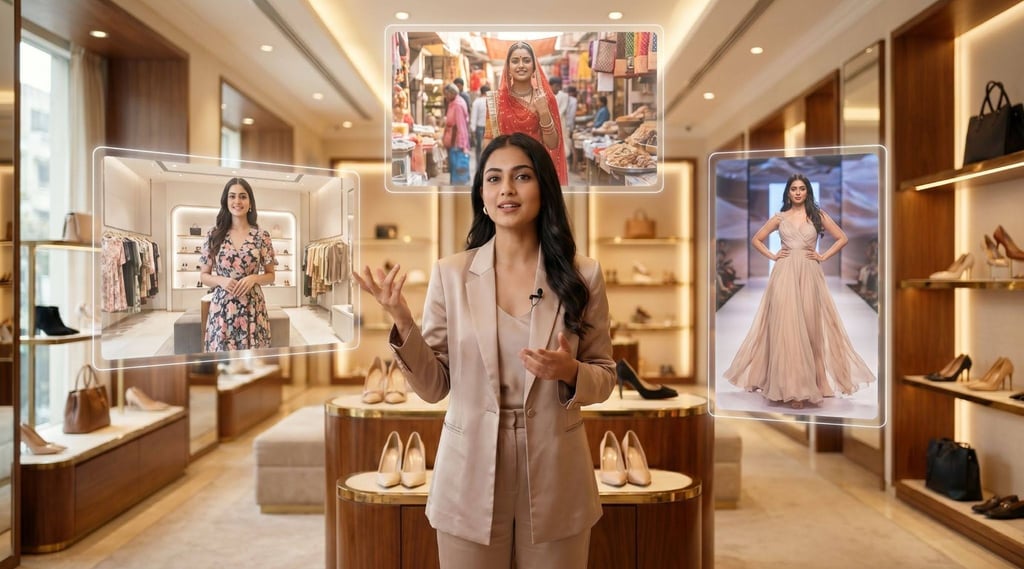
A recent global marketing survey by the World Federation of Advertisers (WFA) found that 77% of brands are now expecting major cost efficiencies from AI-generated brand personas.
Magazine Luiza in Brazil has been quietly running a virtual character called Lu since 2003, and she now sits on more than 30 million followers across platforms. McDonald's worked with her on a product launch and got high engagement and strong memorability because the campaign matched her existing persona of being a friendly, slightly nerdy product reviewer.
Read that again. 30 million followers. For a character that isn’t real.
A few months ago, Sixteen By Nine (SBN) Media built Solar Singh, an AI spokesperson designed for solar marketing in India. He walks across rooftops, snaps his fingers to make bifacial panels float in mid-air, switches to the inside of a home to explain inverters, and closes with a line that lands. He never ages. He never gets into controversies. And he can show up in new locations, new narratives, new languages, in a matter of hours through expert prompting.
Solar Singh is designed for solar marketing. But the conversation he kicked off goes much wider than that. Consider this: Indian brands, with the help of professional AI video studios like SBN Media, can now build AI brand spokespersons and influencers in weeks. We have the tools, the workflows, and the expertise. And the audience, especially Gen Z, is more than ready to engage with these AI brand spokespersons and influencers.
Explore the AI Ads Made by SBN Media for Leading Brands in India
Traditional vs. AI Brand spokespersons
We're not stating that traditional spokespersons don't work. Some of the most iconic brand communication in India still rides on a familiar face. Amitabh Bachchan for Kalyan Jewellers. Virat Kohli for everything from cars to colas. Shah Rukh Khan for innumerable brands.
But here's the hard truth. This marketing model is expensive and several brands cannot afford it. Also, this marketing model is not built for the kind of content velocity a brand actually needs today.
Think about what a typical celebrity campaign costs to keep alive across a year. The fee. The shoot days. The renegotiation when the contract ends. The PR scramble when something goes off-script on a personal handle. The weeks of coordination for sixty seconds of footage. And if you want that same campaign in five languages for five regional markets, you're looking at a logistics problem that quietly eats into the budget you wanted to spend on media.
Now imagine a brand spokesperson you own. A voice that's consistent. A character you can deploy in Hindi, Tamil, Marathi, Telugu, Bengali, and other regional languages with perfect lip sync and dialogue delivery without losing any regional nuance.
This is not a future conversation. This is happening right now.
What an AI spokesperson actually is
An AI brand spokesperson isn't a chatbot with a face. It isn't a voiceover dropped over stock footage. And it isn't one of those wooden talking heads from early avatar tools that always looked slightly off.
A properly built AI spokesperson is a designed visual identity with consistent features, a specific personality, expert dialogue delivery calibrated to your audience, and production-grade visual storytelling around them. It's the difference between a stock image and a brand mascot. One is filler. The other is an asset you build a whole identity around.
Solar Singh works because he was built that way. He has a look. He has a tone. He has a way of moving through scenes that signals confidence without trying too hard. When he explains the difference between Mono-PERC and TopCon panels, the language is calibrated for a homeowner who's about to spend lakhs on a rooftop installation. This level of targeted messaging and brand integration is possible with well-made AI spokespersons.
The trust question and ASCI stance
The single biggest concern marketers raise about AI spokespersons is trust. As per a WFA survey conducted in 2025, 96% of marketers said consumer trust was their main barrier to adopting AI influencers. And in India, the Advertising Standards Council of India (ASCI) has made its position clear. Every post by a virtual influencer needs to carry a prominent AI disclosure alongside the standard ad disclosure. The brand is held fully responsible, not the agency, not the character.
This is actually helpful. It's a clarification.
The brands that are going to win with AI spokespersons are the ones that lean into the disclosure, not the ones that try to hide it. Build a backstory. Give your character a name and an "About" page. Let your audience know what they're engaging with. The Indian Gen Z consumer, in particular, isn't fooled, and they're not bothered by AI characters either. Roughly 40% of Gen Z globally now follow at least one virtual influencer, and around a third have made a purchase influenced by one. Among marketers planning to use AI influencers, 78% already plan to clearly disclose when the character is AI-generated.
The Bottom line
The brands that start building their AI brand spokespersons and influencers now are the ones who'll have a recognisable face, a trusted voice, a following, and a library of assets ready when this trend goes mainstream.
Solar Singh wasn't a one-off experiment for us. He was a proof of concept for a capability we now offer to brands across every category.
SBN Media deploys a craft-led approach to AI video production, with a team that brings filmmaking instinct from FTII into a generative AI pipeline. We've delivered AI ads and brand films for leading brands in India, including Zydus, BirlaNu, and Reliance SMART Bazaar.
If your brand needs a face that connects with people, speaks with authority, scales across languages and markets, and looks the same in 2026 as it will in 2040, we can build that for you.

© Sixteen By NIne Media 2024. All rights reserved.
SBN Media | AI Video Studio & Corporate Film Production – Mumbai, India
Specialized in AI-powered corporate videos, brand films, product ads, and multilingual content