

Picture a solar panel on an Indian rooftop today. It will catch the sun for about 25 summers. Then what? That question sits at the centre of solar panel recycling in India, and it is the subject of Twenty-Five Summers (पच्चीस गर्मियाँ), a 3 minute 35 second short documentary from Sixteen By Nine (SBN) Media and the first title in our SBN Originals line.
A solar panel lasts about 25 years. After that it can be recycled: the frame comes off, the glass is separated and the metals are recovered. About three-quarters of a panel is glass, and most of the rest can be used again. India now has rules on storing old panels and its first recycling plants.
Disclosure: the narration voice is AI, the video contains AI-generated imagery, and the family shown is fictional. Footage also comes from Envato Elements and archive sources.
India’s Solar Boom
India added a record 38 gigawatts of new solar in 2025, according to Ember’s 2026 report. Hundreds of millions of panels now turn sunlight into power. Solar is more widely used and accepted here than at any point before, and every one of those panels has a date on which its first job ends. That growth is good news for the grid. It also starts a clock, because the panels going up this year are the retirements of a quarter century from now, and the planning for them can start today.

What Happens to Solar Panels After 25 Years?
A panel’s working life is about 25 years. After that it leaves the roof or the field, and what happens next depends on whether anyone has planned for it. Left unplanned, a retired panel is waste. Planned for, it is a stock of materials. The rest of the video, and this page, follows that second path.
How Much Solar Waste Is Coming?
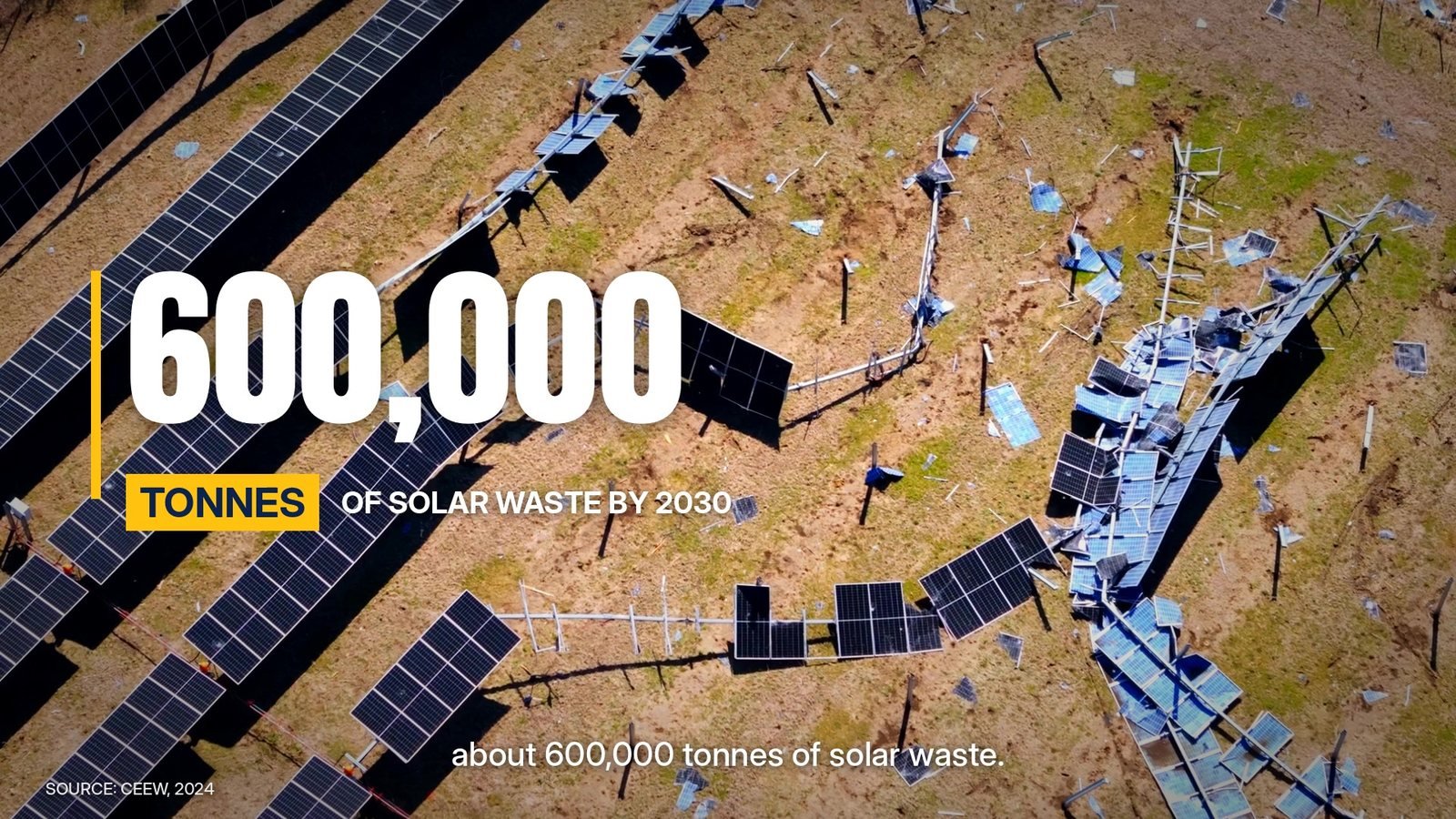
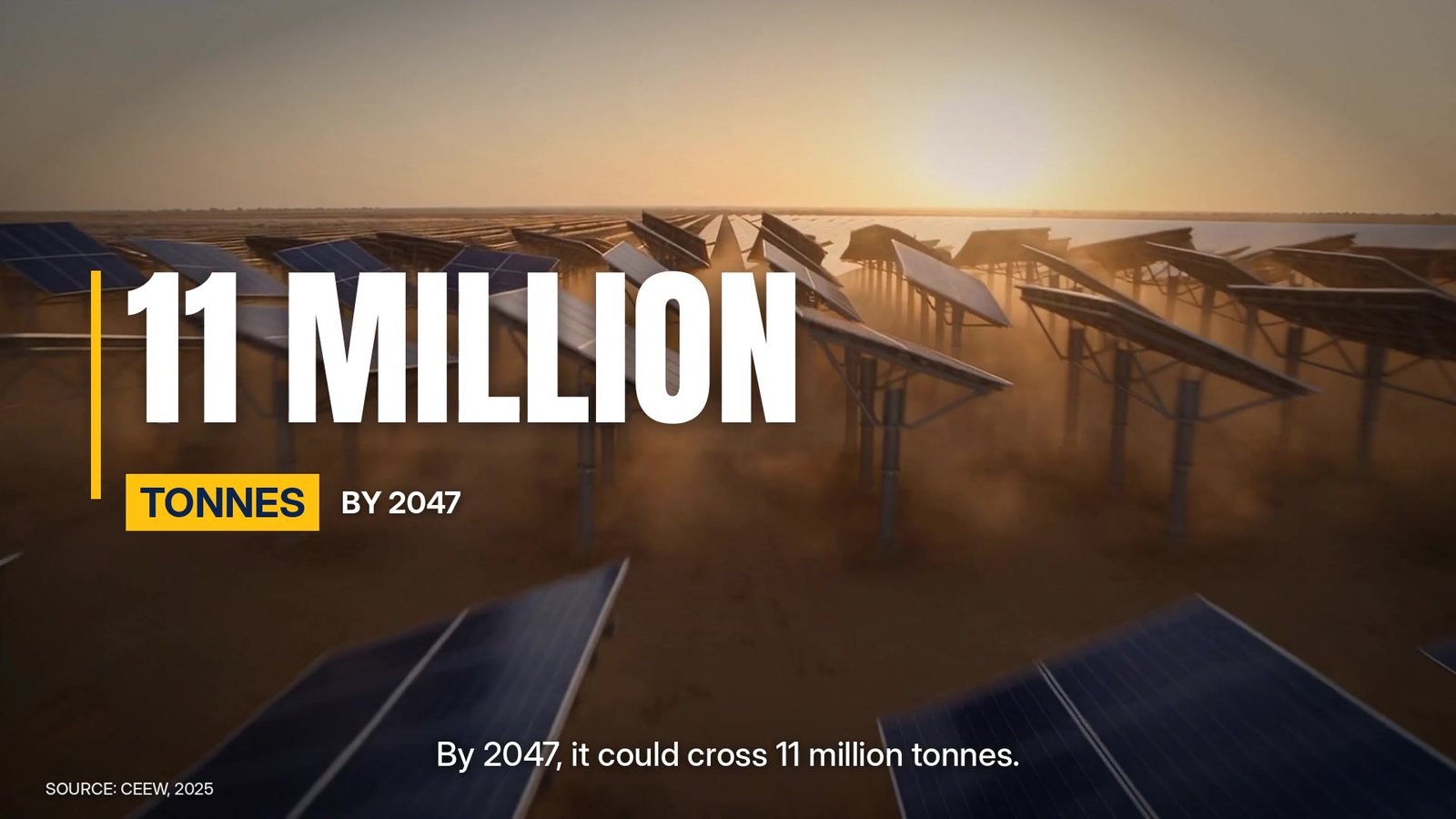
By 2030, India will have about 600,000 tonnes of solar waste, according to the Council on Energy, Environment and Water (CEEW, 2024). That is enough to fill 720 Olympic swimming pools. By 2047, CEEW’s 2025 study says, it could cross 11 million tonnes. A flow that size is a materials stream, and a stream that size can support an industry of its own. The same number can be read two ways. As a disposal task it is large. As a supply of glass, aluminium, silicon, copper and silver that already exists inside the country, it is an opportunity, and the video chooses that reading.
What Is Inside a Solar Panel?
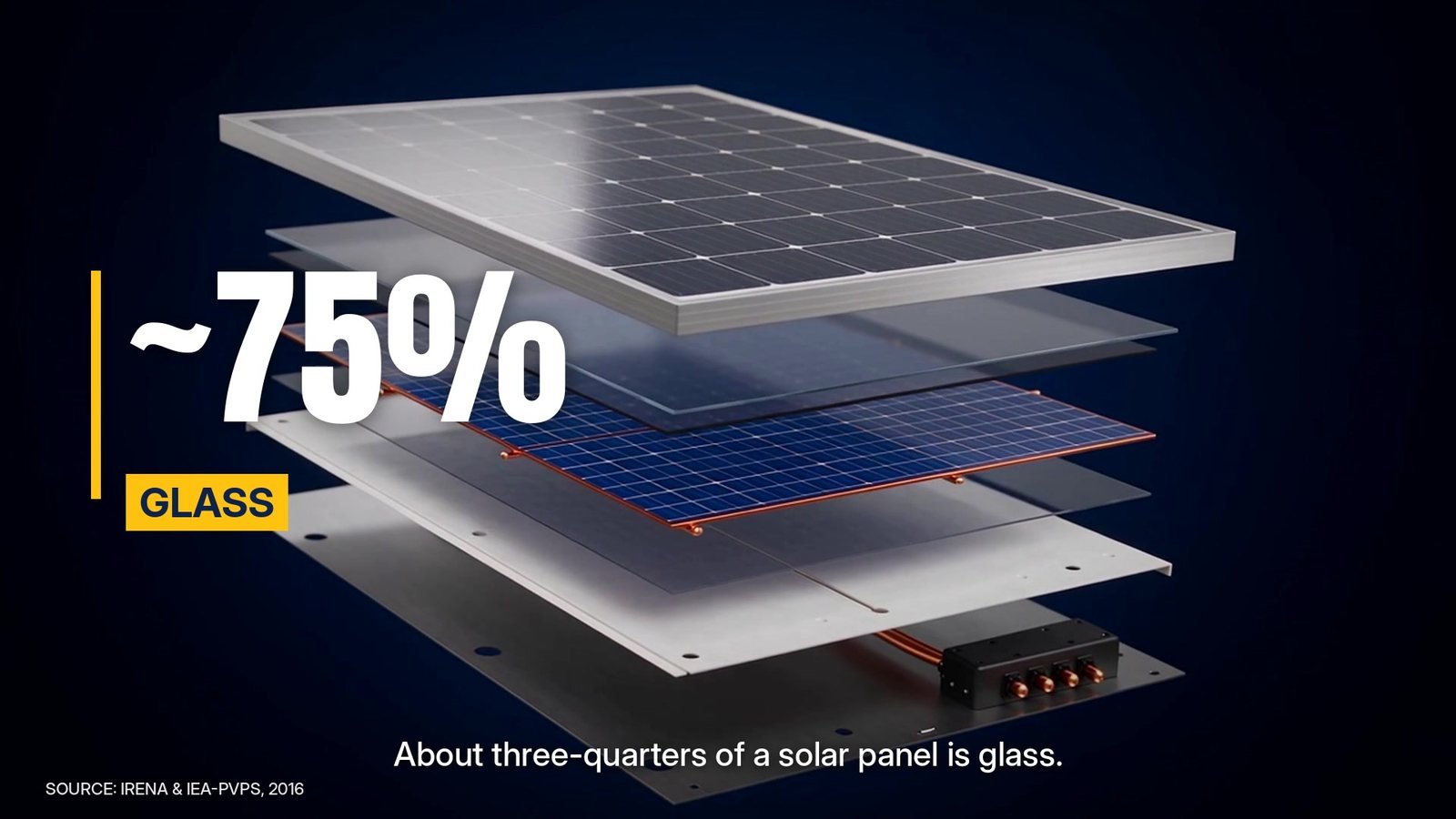
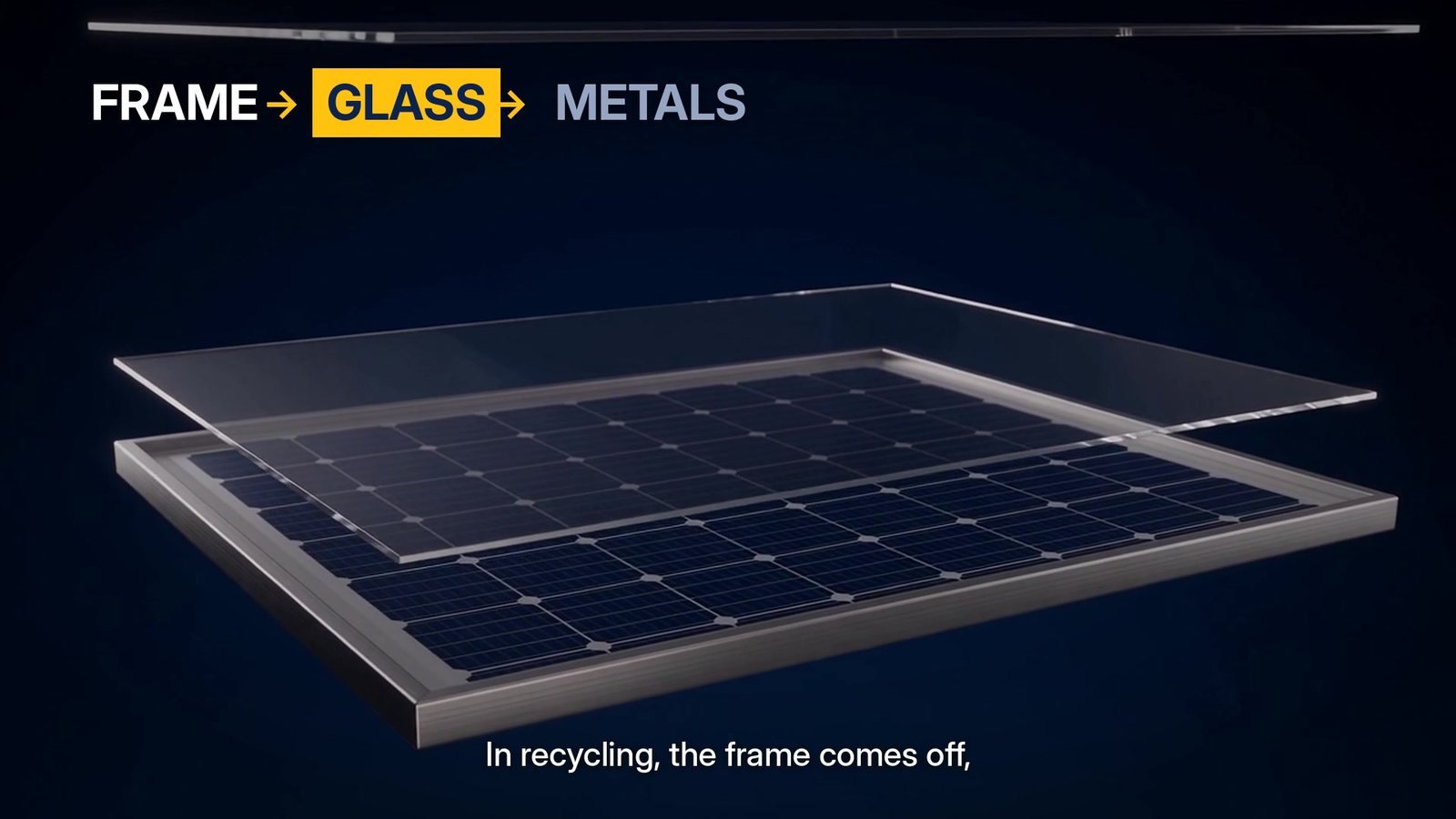
The answer to the question lies inside the panel. About three-quarters of it is glass. The rest is aluminium, silicon, copper and a little silver, and most of it can be used again. In recycling, the frame comes off, the glass is separated and the metals are recovered. So what looks like waste is raw material. The layers of a panel are bonded together, which is why recycling is a matter of taking them apart in the right order: the frame first, then the glass, then the metals.
India’s Rules and the First Recycling Plants
India now has rules for this. Panel makers must store old panels for recycling under the E-Waste (Management) Rules, 2022. Recycling plants have started to come up across the country. It began in 2020 with a small pilot plant in Gummidipoondi, Tamil Nadu, handling 2.5 tonnes a day. Today First Solar’s plant in Sriperumbudur can recycle about 22,000 tonnes a year and recovers around 95% of the material. Jakson Engineers, with Italy’s Ecoprogetti, is setting up a plant to recycle 500,000 panels a year. Rules say where retired panels should go, and plants give them somewhere to go. Each needs the other, and the first plants matter because they show the second half of that pair has begun.
What Could 2047 Look Like?
CEEW’s November 2025 estimates give a way to picture it, and they rest on one condition: that the recovery potential in old panels is realised. If this is done right, by 2047:
- material from old panels could meet 38% of what the industry needs to make new ones
- recycling could become a ₹3,700 crore business
- 37 million tonnes of carbon emissions could be avoided
These are estimates, which is why the video says “could”, and so does this page. The direction is the useful part: materials recovered at home, fewer new inputs to make, and a clean end to a solar panel’s working life.
A Panel’s Second Life
At 25 years a panel stops generating power, and its materials start a second job. The glass, aluminium, silicon, copper and silver recovered from it can come back as a new panel, ready for another twenty-five summers.
Why SBN Originals
SBN Originals is Sixteen By Nine (SBN) Media’s own line of films and series that raise awareness of a sustainable future. They are made with AI video production alongside real footage and archive. Twenty-Five Summers is the first, a short documentary that sets out to answer one question in under four minutes, with every figure credited to the report it comes from. CGI and traditional animation could reach similar visuals, at higher cost and over a longer schedule. The documentary work behind it sits on our documentary production page, and the Originals titles are collected under documentaries.
If you work in solar, our solar video production page shows how we make project and plant videos for the sector, and How Videos Turn Solar EPC Projects Into Marketing and Sales Assets covers the commercial side.
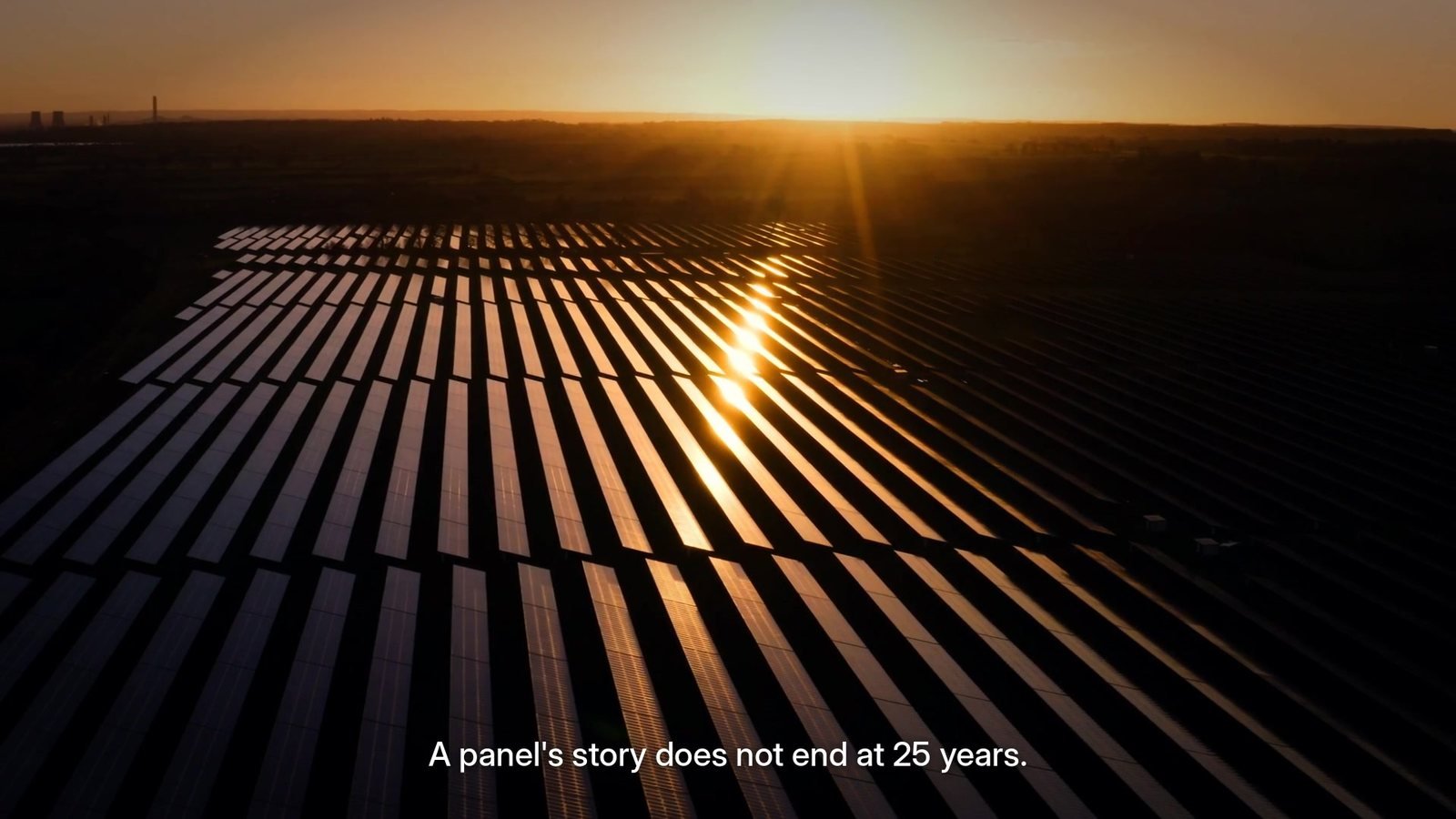
A panel’s story does not end at 25 years.
Frequently Asked Questions
How Long Does a Solar Panel Last?
About 25 years. After that the panel retires from service and its materials can be recovered.
What Happens to Solar Panels After 25 Years in India?
They are meant to be stored and recycled. India now has rules asking panel makers to store old panels for recycling, and the first recycling plants have started. In recycling, the frame comes off, the glass is separated and the metals are recovered.
What Is Inside a Solar Panel?
About three-quarters of a panel is glass. The rest is aluminium, silicon, copper and a little silver. Most of it can be used again.
How Much Solar Waste Will India Have by 2030 and 2047?
About 600,000 tonnes by 2030, enough to fill 720 Olympic swimming pools, according to CEEW (2024). By 2047, CEEW’s 2025 study says, it could cross 11 million tonnes.
Which Companies Recycle Solar Panels in India?
The video names three efforts. A pilot plant began in 2020 in Gummidipoondi, Tamil Nadu, handling 2.5 tonnes a day. First Solar’s plant in Sriperumbudur can recycle about 22,000 tonnes a year and recovers around 95% of the material. Jakson Engineers, with Italy’s Ecoprogetti, is setting up a plant for 500,000 panels a year.
Is the Narration Real or AI?
The narration voice is AI. The video also contains AI-generated imagery, and the family shown is fictional. Other footage comes from Envato Elements and archive sources.
Read the Transcript
India’s solar boom. In India, solar energy is now far more accepted and widely used. In 2025 alone, India added a record 38 gigawatts of new solar. Today, hundreds of millions of panels turn sunlight into power.
Every panel has a lifespan. But every panel has a lifespan. About 25 years. After that, these panels become waste.
How much waste is coming. And this waste is growing fast. By 2030, India will have about 600,000 tonnes of solar waste. Enough to fill 720 Olympic swimming pools. By 2047, it could cross 11 million tonnes.
So what happens to the old panels. So what happens to all these old panels?
Inside a solar panel. The answer lies inside the panel. About three-quarters of a solar panel is glass. The rest: aluminium, silicon, copper and a little silver. Most of this can be used again. In recycling, the frame comes off, the glass is separated, and the metals are recovered. So what looks like waste is really raw material.
India’s rules and the first recycling plants. India now has rules for this. Panel makers must now store old panels for recycling. And recycling plants have started coming up across the country. It began in 2020 with a small pilot plant in Gummidipoondi, Tamil Nadu, handling just 2.5 tonnes a day. Today, First Solar’s plant in Sriperumbudur can recycle about 22,000 tonnes a year and recovers around 95% of the material. And Jakson Engineers, with Italy’s Ecoprogetti, is setting up a plant to recycle 500,000 panels a year.
What 2047 could look like. If this is done right, by 2047… Material from old panels could meet 38% of what the industry needs to make new ones. It could become a ₹3,700 crore business. And avoid 37 million tonnes of carbon emissions.
A panel’s second life. A panel’s story does not end at 25 years. It can come back, as a new panel. For another twenty-five summers.
Sources and Credits
Sources: Council on Energy, Environment and Water (CEEW), 2024. CEEW, press release on India’s solar module recycling studies, 6 November 2025 (https://www.ceew.in/node/4745). IRENA and IEA-PVPS, End-of-Life Management: Solar Photovoltaic Panels, 2016. Ministry of Environment, Forest and Climate Change, E-Waste (Management) Rules, 2022. Ember, 2026.
Twenty-Five Summers is an SBN Originals short documentary by Sixteen By Nine (SBN) Media, Mumbai. Hindi narration with English subtitles. Directed and produced by Gourav Ghosh. Video: youtu.be/VG2jvKf8IOo (channel: SBN Studios, published 29 Oct 2026).
Archive and image credits: NASA / Solar Dynamics Observatory (public domain). Down To Earth (“Solar Suresh”, “Net metering”). SELCO Foundation (“Solar Village”, “Voices from the Field on Solar Cold Storages”). RESET COMPANY (“Solar Panel Recycle Solutions”). Abloomax (recycled PV glass). Solargis satellite imagery, contains modified Copernicus Sentinel data (2016, 2018, 2020). Map data: DataMeet (CC BY 2.5 IN). Stock footage licensed from Envato.
AI Disclosure
The narration voice is AI. The video contains AI-generated imagery. The family shown is fictional.
Have a Solar Story to Tell?
Tell us about the project or the topic and we will write back. Or write to info@sbnmedia.in.