
Easy Multilingual Video Strategy for Pan-India Brands
Why Multilingual Videos Matter for Pan-India Brands
SBN MEDIA TEAM
3/17/20268 min read
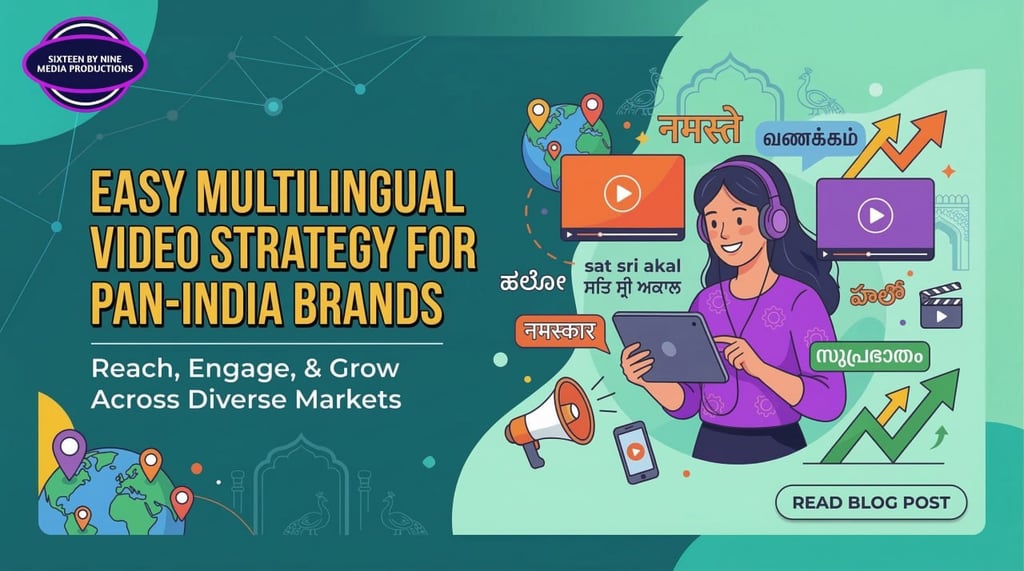
India is not one market. It is many markets sharing geography. Twenty-two official languages. Hundreds of dialects. Thousands of years of distinct regional cultures, each with its own stories, sensibilities, and ways of seeing the world. A brand operating across Maharashtra, Tamil Nadu, Gujarat, West Bengal, and Punjab is not running one campaign. It is speaking to five different worlds.
Hindi connects a large part of the country, but for hundreds of millions of Indians, it is still a second language. The mother tongue is where trust lives.
Video, more than any other format, depends on emotional connection. And nothing creates a connection faster than language. When someone hears their own language in a brand video, the brand message becomes more familiar and is communicated more effectively.
The numbers support this. Google and KPMG research on Indian language internet users found that regional language content drives significantly stronger purchase decisions compared to English content, particularly among Tier 2 and Tier 3 audiences who make up the majority of India's next wave of consumers.
For pan-India brands, the question is no longer whether to invest in multilingual video. India's diversity makes that answer obvious. The question is how to do it smartly, without making the process expensive or unmanageable.
What "Multilingual Video Strategy" Actually Means
A common misunderstanding is that multilingual video means shooting a completely separate video for each language. That model exists, and sometimes it is the right choice. But for most brands, it is neither practical nor necessary.
A multilingual video strategy is about making deliberate decisions at every stage of production that allow your core content to travel across languages and regions efficiently.
This includes decisions about:
How the script is written
What appears on screen versus what is spoken
Whether you use dubbing, subtitles, or a combination of both
Which languages to prioritise based on your actual market presence
How much cultural adaptation is needed beyond just language translation
Getting these decisions right in pre-production is what separates a scalable multilingual strategy from a costly one.
The Master Plus Adapt Model
The most practical framework for pan-India brands is what we call the "master plus adapt" model.
You produce one well-crafted master video. This master is planned from the start with AI-powered regional adaptation in mind. Then, from that master, you create regional versions through translation, dubbing with precise AI-powered lip sync, subtitling, or selective re-shoots where cultural context genuinely requires it.
This approach works because:
Your core creative investment goes into one strong master
Adaptation costs are significantly lower than original production costs
Quality remains consistent across all versions because the visual backbone is the same
Timelines are faster for regional versions since creative decisions are already locked
At Sixteen By Nine (SBN) Media, this is the model we recommend to most brands looking to expand their video presence beyond Hindi and English.
Step 1: Start With a Language-Agnostic Script Structure
The foundation of any good multilingual video is a script that is built to travel.
What does that mean in practice? It means writing a script where the core message lives in the visuals and the story structure, not just the words. When your video relies heavily on on-screen text, graphics, or demonstrations to communicate key points, those elements stay constant across all language versions. Only the voice and subtitles need to change.
Some practical principles for multilingual-ready scripts:
Keep spoken sentences short and direct. Long, complex sentences are harder to dub accurately and often do not translate cleanly.
Avoid idioms, wordplay, or cultural references that are specific to one region. What works in a Mumbai boardroom may not resonate in Ahmedabad or Chennai.
Leave room in the edit for text expansion. Languages like Tamil and Bengali often take more words to express the same idea as Hindi or English. Build breathing room into your pacing.
Plan your on-screen graphics to be language-neutral where possible. Numbers, icons, and visual demonstrations translate without any additional production work.
This is not about making your master video generic. It is about making your master video structurally sound enough to carry weight in multiple languages.
Step 2: Choose the Right Localisation Method
Not all multilingual adaptations are the same. The right method depends on your content type, your audience, your budget, and what level of connection you want to create. AI has made every option on this list faster, more affordable, and easier to scale.
Subtitling
Subtitling is the most cost-effective option. A well-produced subtitle track in regional languages makes your video accessible without requiring any audio production. It works well for informational or educational content, B2B content where the audience is typically more engaged, and social media content where videos often play without sound anyway.
AI tools can now generate accurate subtitle tracks in regional languages within hours, reducing what once took days of manual transcription and translation. The limitation of subtitling is that it keeps some distance between the viewer and the content. For brand films or emotionally driven content, this can reduce impact.
Dubbing
Dubbing replaces the original audio track with a recording in the target language. When done well, it creates the most natural viewing experience because the viewer hears the content in their own language without the cognitive load of reading subtitles.
Dubbing works best for brand films and corporate videos where tone and emotion matter, training and onboarding videos where retention is the goal, and long-form content where subtitle fatigue becomes a factor.
AI-powered dubbing has transformed this process. Brands can now generate natural-sounding voice tracks in multiple regional languages without studio scheduling, casting, or long lead times. For high-volume campaigns or brands entering new markets quickly, AI dubbing delivers quality at a speed that was simply not possible before.
Regional Voice-Over
For many corporate and industrial videos, the visual content stays the same but the narrative is spoken over it. Regional voice-over is a clean and efficient solution here. You record separate voice-over tracks for each language and the video itself remains unchanged. This works particularly well for product demos, factory tours, and brand introduction videos where the visuals do the heavy lifting.
AI voice-over tools have expanded this option considerably. We can now generate regional voice tracks at speed across multiple languages simultaneously, making it viable to cover more markets without proportionally increasing cost or timelines.
AI-Powered Selective Re-creation
Some markets need more than translation. Festivals, food, clothing, and local environments require scenes that feel genuinely local. With AI, these elements can be recreated digitally, swapping backgrounds, outfits, or cultural details without organising an entirely new shoot.
This is where AI delivers its most significant advantage. What was once the most expensive and time-consuming adaptation option is now fast, flexible, and manageable. A single master production can be made to feel truly local across multiple markets without repeating the shoot.
Step 3: Prioritise Languages Based on Market Presence
A pan-India brand does not need to be present in every Indian language simultaneously from day one. The goal is a smart, phased approach based on where your actual customers are.
As a practical prioritisation framework, start with your top three markets by revenue or growth. Identify the primary language of your customer base in each market. Build your first round of regional adaptations around those three languages.
For most manufacturing and industrial brands we work with, the first tier typically includes Hindi, Tamil, and either Gujarati or Kannada, depending on where their distribution or client base is concentrated.
From there, you can add Bengali, Telugu, Marathi, and Malayalam in a second phase as your regional presence grows. This phased approach makes the investment manageable and allows you to measure the impact of localisation before scaling further.
Step 4: Work With Professional Regional Translators, Voice Artists, and AI
Translation quality is where many brands compromise and end up with content that reads as foreign, even though it is technically in the local language.
Human Translation Still Matters
Machine translation tools have improved considerably. For internal use or rough drafts, they are useful. But for brand-facing content, professional human translation is essential. A good regional translator does more than convert words. They adapt the tone, the register, and the cultural framing to match how people in that region actually speak and think about the subject.
Where AI Changes the Game
AI translation and dubbing tools have made regional adaptation dramatically more accessible. What previously required weeks of coordination across translators, voice artists, and recording studios can now be initiated within hours. AI can generate a first-cut regional script, produce a natural-sounding voice track, and sync it to the video in a fraction of the traditional time and cost.
For brands producing across 4 or 5 languages simultaneously, this is a genuine shift. Instead of managing multiple vendors and timelines in parallel, a single AI-assisted workflow handles the volume cleanly and consistently.
Step 5: Distribute With Language Context
Producing multilingual videos is only half the job. The distribution strategy needs to match.
A few principles for multilingual video distribution in India:
Upload language-specific versions as separate videos with clear language labelling in the title and description. This helps platforms serve the right version to the right audience.
On YouTube, use language tags and regional targeting to ensure your Tamil version surfaces to Tamil-speaking audiences, not as a secondary option buried under your Hindi master.
On LinkedIn and Instagram, geo-targeted posts allow you to serve the regional version to users in specific states.
For internal communications, create a clear asset library that teams in each region can access without confusion.
The distribution step is often underplanned. Brands invest in production and then upload everything as one playlist with no regional context. A small amount of planning here significantly increases the reach and effectiveness of your multilingual content.
What This Looks Like in Practice: An AI Campaign Example
Overview:
During the festive season, Reliance SMART Bazaar needed a large-scale ad campaign, fast. Traditional production would have taken months. With AI, it was done in 7 days.
What Was Delivered:
SBN Media produced 64 ready-to-run ad films from 8 creative concepts, localised across 4 languages (Hindi, Tamil, Telugu, and Kannada), and formatted for both TV and mobile. That is 8 concepts x 4 languages x 2 formats = 64 videos, all in under a week.
How AI Made It Possible:
Scripts, visuals, and voiceovers were developed in parallel. AI handled photoreal visual generation while human directors curated and composed every shot. Each 15-second cut was tight, offer-forward, and platform-ready from day one.
Summary:
This project was all about speed without compromise, and creating AI Videos with such creativity and techniques that don’t look like AI. Reliance SMART Bazaar wanted cinematic, energetic ad films that read perfectly in 15 seconds. That meant SBN Media invested heavily in prompting, timing, and language adaptation upfront so each cut hit the offer, visually and emotionally, with no wasted frames.
This campaign proved that high-volume, multi-market content no longer needs months of production time. AI, paired with the right creative direction, delivers at a speed and scale that traditional production simply cannot match.
Watch Reliance SMART Bazaar Festive Campaign Videos:
Watch the SMART Bazaar Video here.
Common Questions About Multilingual Video Strategy
How much does multilingual video adaptation typically add to production cost?
Dubbing and voice-over adaptation generally adds 15 to 30 per cent to the cost of the master video per language, depending on video length and the complexity of the adaptation required. Subtitling is typically less than 5 to 10 per cent per language. AI dubbing can reduce these costs further, particularly for brands producing across multiple languages at once.
Do we need to adapt visuals for regional versions?
In most cases, no. Visual adaptation is only necessary when your content contains culturally specific elements that do not translate across regions. For most corporate, industrial, and B2B content, the visuals remain the same across all versions.
How long does regional adaptation take?
For subtitling, turnaround is typically 1 to 2 working days per language once the master is approved. For dubbing with professional voice artists, expect 2 to 3 working days. AI dubbing can significantly compress this timeline, often delivering regional audio tracks within a day per language.
Can we use AI dubbing instead of human voice artists?
AI dubbing has improved significantly and offers real advantages: faster turnaround, lower cost per language, and the ability to scale across many languages simultaneously without booking studio time. For internal communications, social media content, and high-volume campaigns, AI dubbing is a strong and practical choice. For flagship brand films or content where tone and emotional credibility are critical, human voice artists still deliver a more refined result. The smartest approach is often a combination: AI dubbing for volume and speed, human artists for hero content.
SBN Media - Experts in Multilingual Video Production
Multilingual videos often are the difference between content that reaches people and content that actually moves them.
At SBN Media, we handle the full scope of this work. We build master videos designed from day one to travel across languages, then adapt them through AI-powered dubbing, regional voice-over, subtitling, and selective visual recreation. Our AI-assisted workflow means you are not waiting weeks for each language version. You are getting market-ready content across Hindi, Tamil, Kannada, Gujarati, Bengali, Marathi, and other regional languages, in a fraction of the traditional time and cost.
If your brand is present across multiple states but your video content is still speaking in one language, you are leaving a significant portion of your audience underserved.
Get in touch with SBN Media today to build a multilingual video strategy that fits your market, your budget, and your timeline.
© Sixteen By NIne Media 2024. All rights reserved.
SBN Media | AI Video Studio & Corporate Film Production – Mumbai, India
Specialized in AI-powered corporate videos, brand films, product ads, and multilingual content