How AI VFX Is Changing What Video Production Can Deliver
Faster, smarter, limitless visuals.
SBN MEDIA TEAM
3/17/20268 min read
Visual effects have been part of film and television for decades. What has changed is access. Who can use them, at what cost, and at what speed?
Traditional VFX requires specialist artists, dedicated software, long render times, and a significant budget. A single composited shot in a feature film can take weeks of skilled labour. That model makes sense for high-investment productions where the per-shot cost is justified by overall scale and commercial return. For most brands producing regular content, that model has simply never been accessible.
AI VFX works differently. It uses trained generative models to understand the visual context of footage and produce transformations that fit naturally within that context. The model does not need manual instruction on every pixel. It uses that understanding to produce output that integrates with the source material rather than sitting on top of it.
The practical implication is significant. Visual transformations that once required dedicated VFX teams and multi-week production pipelines can now be achieved faster, at lower cost, and with results that hold up to broadcast scrutiny. That shift in the cost and time equation is what makes AI VFX genuinely useful rather than simply interesting.
This is not a faster version of what already existed. It is a different category of capability, and it is changing what production teams can deliver for clients. Historically, "fixing it in post" was a phrase of last resort, an expensive admission that something had gone wrong on set. AI VFX flips this narrative, transforming post-production from a corrective phase into a generative one. Because the technical barrier to complex visual shifts has been lowered, directors and editors are no longer locked into the first "usable" version of a shot.
The Production Problem It Solves
Every video production involves constraints. Budget limits crew size. Scheduling limits shoot time. Location limits the environment you have access to on a given day. These constraints are real, and they show up in footage whether you plan for them or not.
Traditional VFX has always been capable of overcoming these constraints. A sparse crowd can be filled. Branding can be composited into a shot with precision. A flat-lit scene can be transformed to match broadcast quality. The work is real, the results are proven, and for high-budget productions, it has been the standard solution for decades.
The constraint was never creative. It was financial. High-quality traditional VFX requires specialist artists, dedicated software pipelines, significant turnaround time, and budgets that several brands simply do not have access to.
AI VFX moves that boundary for productions at every budget level. A shot with a sparse crowd can become a packed arena. A location with no visible branding can have logos added that look like they were present on the day of the shoot. A flat-looking shot can be upgraded to match the visual standard of a fully produced broadcast. The creative capability that once required a dedicated VFX house and a substantial line item in the budget is now accessible within a professional AI production workflow, at a fraction of the time and cost, without returning to the location or reshooting a single frame.
How SBN Media Transformed PWL's Footage with AI VFX
Pro Wrestling League is one of India's most established sports entertainment properties, with broadcast visibility and a recognisable roster of athletes who have built audiences over multiple seasons. The footage we worked with came from actual PWL event production, shot on a real shoot with real production constraints.
Watch the Before and After Footage Here:
The goal was to take that footage and bring it to the standard that broadcast-quality output requires. This involved four distinct transformation tasks, each addressing a different gap between what was captured and what the finished content needed to look like.
Improving Raw Shot Quality
AI-assisted processing was applied to elevate the captured shots. Detail, depth, sharpness, and overall visual quality were improved across the footage. The content of the shots remained entirely the same. What changed was how they looked on screen, moving from functional but flat to sharp, polished, and production-ready.
Adding Logos and Brand Elements
Sponsorship is central to how sports entertainment properties like PWL generate revenue, and one of the persistent challenges in sports production is demonstrating sponsor value before an event has taken place. Showing a sponsor a media kit with projected audience numbers is one thing. Showing them exactly how their logo will look on the mat, on the arena banners, and in motion on a broadcast camera angle is another.
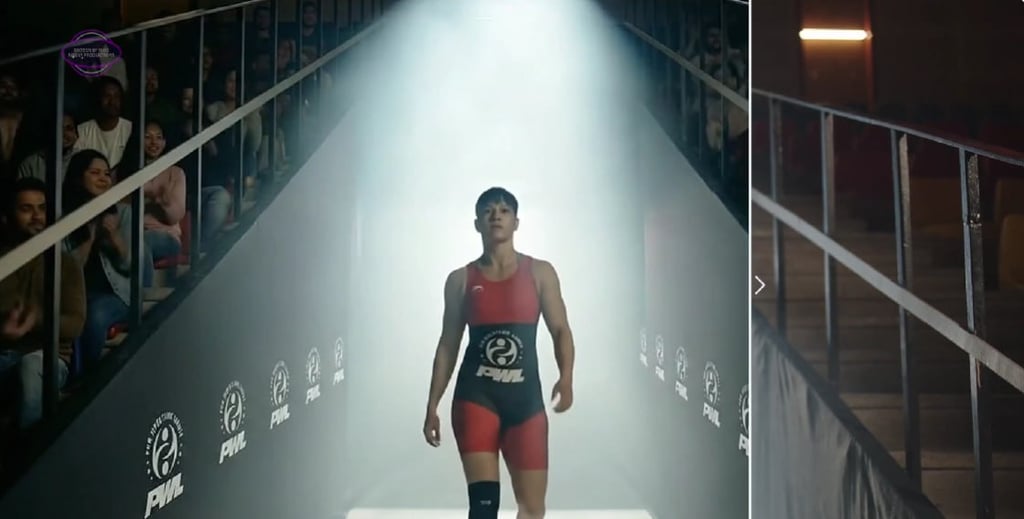
SBN Media's AI VFX workflow allowed us to place Virtual Sponsor Graphics directly onto the wrestling mat and arena environment, with motion tracking that kept them locked naturally to the surface as the camera moved. These were not static overlays. They moved with the footage, responded to the camera, and sat within the visual environment of the arena rather than on top of it. The result looked like the branding had been physically present on the day of the shoot.
This Visual Proof of Concept is a genuinely powerful commercial tool. For leagues and events in their pre-launch or pre-season phase, being able to show prospective sponsors a photorealistic simulation of their brand in a broadcast environment accelerates conversations that would otherwise stall at the proposal stage. It removes the imagination gap that sponsor decks typically ask partners to bridge, and replaces it with something they can see and evaluate directly.
Building Audience Presence
SBN Media used AI VFX to build out a realistic audience presence across the PWL footage. This was not a simple fill or a looped crowd texture. The AI VFX was done in accordance with the spatial logic of the arena environment, the way light fell across the seating areas, the natural variation in how a real audience distributes itself, and the movement and energy that a live crowd generates. The output was a realistic representation of a well-attended event.
The before and after difference in perceived event scale is significant. The same athletes, the same ring, the same camera work, but with an audience presence that matches the energy of the performance. That alignment between what is happening in the ring and what the viewer sees in the stands is what makes the finished footage feel complete.
SBN Media’s AI VFX Toolkit
The workflow used Veo 3.1 and Google Nano Banana, with final assembly and all editorial work completed in Final Cut Pro.
Veo 3.1 is Google's current-generation video model. It handles video generation and transformation with a strong understanding of scene context, producing output that integrates with the visual language of the source material rather than sitting apart from it. This scene-level understanding is what makes the generated elements appear as part of the original footage.
Nano Banana is an advanced AI image generation and editing model developed by Google DeepMind. It is capable of creating high-fidelity, 4K resolution visuals with consistent character editing, precise text rendering, and advanced style controls.
Final Cut Pro is where human editorial judgment shaped everything into a finished piece. The AI-generated visuals were reviewed, assessed against the source footage, and assembled by the editorial team. Pacing, sequencing, quality decisions, and the choices that determine what the content ultimately communicates were all made at this stage.
Veo 3.1, Nano Banana, and Final Cut Pro are genuinely powerful tools. But getting the best out of these tools requires expert prompting, advanced AI video production workflows, and an understanding of core filmmaking principles. Our team used precise, informed prompting, built on a clear understanding of what the shots needed to communicate and what the models are capable of delivering, to produce output that met the client’s expectations.
Why This Capability Extends Beyond Sports
The PWL project is a sports entertainment example. The capability it demonstrates is not limited to this category.
Any brand that produces video content regularly runs into the same production reality: what the camera captured does not always fully represent what the shoot set out to achieve. AI VFX closes that gap, and it does so across industries.
A real estate developer shooting a residential property may have footage captured on an overcast day or with minimal foot traffic visible during an open event. Environment enhancement and atmosphere improvement can bring that footage to the visual standard the project needs without a return visit to the site.
A corporate brand running an annual conference may have keynote footage where the hall reads as less full on camera than it was in person. Audience augmentation makes the footage reflect what actually happened, rather than the limitations of the camera angle.
In each case, the production took place. The footage exists. AI VFX addresses the gap between what was captured and what the finished content needs to communicate, without requiring additional shoots, high budgets, or additional time on location.
AI VFX also addresses the relentless demand for content volume. Modern brands rarely need a single "hero" asset; they need a library of content tailored for different platforms, regions, and demographics. AI VFX allows for seamless versioning that was previously a logistical nightmare.
A single master shot can be localised by swapping out background signage for different markets or adjusting environmental elements to suit specific seasonal campaigns. Production teams with expertise in AI VFX can now maintain a premium, broadcast-standard aesthetic across an entire ecosystem of social clips, ads, and long-form videos. This scalability ensures that high production value is no longer a one-off luxury, but a repeatable standard that can be applied to every frame a brand puts into the world.
Frequently Asked Questions
What kinds of footage benefit most from AI VFX?
Footage where the core subject is clearly captured, but the surrounding context needs improvement. Sparse crowds, missing branding, flat lighting, and locations that are functional but not visually distinctive are all strong candidates.
Does the source footage need to be high quality?
A baseline of technically usable footage is necessary. AI transformation works best when the source material is sound. It is a powerful upgrade tool, but it works from a foundation rather than from unusable material.
How is this different from standard post-production?
Standard post-production adjusts and refines what was captured. AI VFX can add, replace, or build elements that were not present in the original shot. That is a different category of capability with a different range of applications.
How long does an AI VFX project take?
It depends on the scope and volume of footage involved. Short-form content with focused transformation tasks can be completed in days. Larger projects with multiple transformation types take longer but remain significantly faster than traditional VFX pipelines.
Can SBN Media apply this to footage a brand already has in its library?
Yes. AI VFX is particularly well-suited to existing footage that was captured under practical constraints and received minimal post-production treatment. Many brands have a library of usable material that can be upgraded without any additional shooting.
Is this only relevant for entertainment brands?
It applies across industries. The transformation types used on the PWL project all have direct equivalents in corporate, manufacturing, real estate, and event video production contexts.
What Good AI VFX Looks Like in Practice
The benchmark for AI VFX output is simple and consistent: a viewer watching the finished content should see a well-produced video. They should have no reason to look for the process behind it. When the digital seams show, the suspension of disbelief breaks, and the viewer’s attention shifts from the message to the methodology.
When AI transformation is visible, something in the workflow did not hold. A crowd that reads as artificial, a logo that sits slightly off-plane, or an environment that looks generated rather than real are more than just technical glitches. These are signs that the integration work was not thorough enough, and they create exactly the kind of distance between a brand and its audience that good production is supposed to eliminate. In the "Uncanny Valley" of AI video production, a shot that is almost right is often more distracting than one that is clearly stylised. If a viewer spends even a split second questioning the physics of a shadow or the perspective of a digital billboard, you have lost their engagement.
When the work is done correctly, none of that is present. The viewer watches footage that looks like it came from a fully resourced, well-planned broadcast production. The tools that created that result are invisible because they are supposed to be.
At SBN Media, this is the standard we hold all AI-assisted production work to. The output has to hold up to the same scrutiny as any other professionally produced video. If it does not, it goes back for refinement before it reaches distribution.
If you are a brand that wants AI VFX to deliver real creative and commercial results, SBN Media is the right production partner for you.
To discuss your next project, click the "Contact Us" button below or reach out to us directly at info@sbnmedia.in
© Sixteen By NIne Media 2024. All rights reserved.
SBN Media | AI Video Studio & Corporate Film Production – Mumbai, India
Specialized in AI-powered corporate videos, brand films, product ads, and multilingual content