How SBN Media Delivered a 15-Language Multilingual Dub for K.O. Mark
Professional-level Multilingual Video Dubbing is Now Accessible to All Brands
SBN MEDIA TEAM
4/19/20268 min read
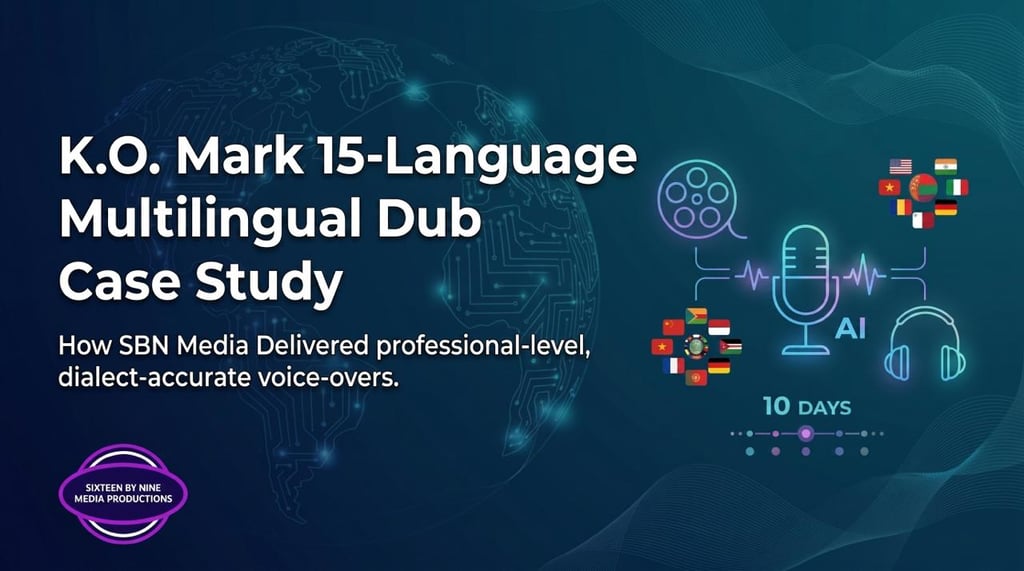
Brands today operate in a global marketplace. A product video that performs well in one market has the potential to reach audiences across ten more, provided the language and tone are right. For companies with international distribution, multilingual dubbing is part of the core content strategy.
The K.O. Mark project brought this reality into sharp focus. The client required professional dubbed audio tracks across fifteen international languages, each following specific dialect standards, each needing to sound natural while maintaining brand hygiene. This was not a straightforward translation job. It was a precision production task, and one that required both advanced AI tools and experienced human oversight to get right.
At Sixteen By Nine (SBN) Media, we have been building our AI-assisted production capabilities over the past few years. This blog will take you through the aspects where AI excels, where it needs guidance, and what it takes to deliver genuinely broadcast-ready multilingual content at scale.
Watch K. O. Mark Video: https://vimeo.com/1163971602
The Project Brief: 15 Languages, Strict Dialect Standards
The project scope called for fifteen languages: Spanish, French, Portuguese, Thai, Urdu, Indonesian, Malay, Turkish, Russian, Vietnamese, Chinese, Japanese, Korean, Polish, and Italian.
This number alone tells you something about the complexity involved. Each language carries its own phonetic rules, rhythm patterns, and cultural nuances. What sounds natural to a native speaker can sound stiff and mechanical if the AI model has not been fine-tuned for that specific dialect or register.
The dialect requirement added another level of precision. Portuguese, for instance, had to sound specifically like Brazilian Portuguese. European Portuguese has a different cadence, different vowel sounds, and different colloquial patterns. Getting this wrong would have been immediately noticeable to the target audience, undermining the credibility of the entire production. The same consideration applies to other languages where regional dialects carry significant weight.
Our production team evaluated the requirements carefully before selecting our tools and workflow.
Choosing the Right Tools: Why We Moved Away from Vmeg.ai
Our initial plan included Vmeg.ai, a platform that promised automatic dubbing with voice cloning built into its workflow. The proposition was appealing because an integrated pipeline can theoretically reduce the number of steps between translation and final output. We subscribed to the platform to test its capabilities on the K.O. Mark project.
The results from Vmeg.ai were not meeting the production standard we needed. The editing was inconsistent: some sections of speech were rushed, while others were stretched out to the point where the pacing felt unnatural. There were also variations in the voice across segments, which is particularly problematic in a dubbing context where consistency is non-negotiable.
We assessed the output carefully and made the decision to shift our approach. Rather than continuing with an integrated platform that was not delivering the quality required, we moved to generating the audio tracks directly through ElevenLabs and handling the editing in-house.
This decision added more steps to the workflow but gave us far greater control over the final output. In professional production, control is always worth the additional effort.
Why ElevenLabs Became the Core of Our Workflow
ElevenLabs has established itself as one of the most capable AI voice platforms available for multilingual content production. The voice cloning feature was especially important for this project.
Voice cloning allowed us to maintain a consistent vocal identity across every language track. When a viewer switches between the English version of the video and the Spanish or Korean version, the underlying voice characteristics should feel related, even when the language is different. This consistency is part of what makes high-quality multilingual content feel professional rather than assembled from separate components.
For every language track, we used expert prompts in ElevenLabs to set the tone of the audio exactly as needed.
The Real Work: Solving Pronunciation, Consistency, and Translation Problems
One of the first issues we identified was with the brand name itself. The name "K.O." was being pronounced as "co" by the AI voice model across multiple language tracks. For a branded piece of content, getting the brand name right is non-negotiable. This required targeted regeneration.
The specific challenge here was that correcting one line in isolation created a new problem: voice consistency. If we regenerated only the line containing the brand name, the tonal quality of that segment would differ slightly from the surrounding audio. The safest solution, and the one we chose, was to regenerate the entire voice-over rather than patching individual lines. This preserved the natural flow and consistent voice quality that the production required.
Voice consistency is a topic that does not always receive enough attention in conversations about AI dubbing. It is relatively easy to generate a single, clean audio line. Maintaining exactly the same voice characteristics across an entire script, across multiple generations, across corrections and revisions, is a significantly more complex task. Our workflow for K.O. Mark was built around this requirement from the start.
We generated complete audio clips for all fifteen language tracks and delivered the first round to the client for review. Even at this stage, with ElevenLabs performing at a high level, there were specific issues that required correction. This is a normal part of any AI-assisted production workflow.
When the Script Itself Needed to Change
Some of the most interesting production decisions on this project came from the translation layer rather than the voice generation layer.
In the Korean dub, certain phrases were not rendering naturally in the target language. Rather than forcing the AI to produce a Korean equivalent that sounded awkward, we replaced those phrases with their English equivalents. This approach is common in multilingual content production. Audiences are generally comfortable with brand names, technical terms, and certain idiomatic expressions remaining in English, particularly in commercial and product video contexts.
The Urdu dub presented a similar situation, and it illustrated a limitation that anyone working with AI translation tools should understand: literal translation.
One line in the script included the phrase "You get an eagle eye's view." The AI translation rendered this into Urdu as "Aap parindo ke nazar se dekh paayenge," which translates roughly to "You will see from the perspective of birds." This is technically accurate as a translation, but it does not work idiomatically in Urdu-language commercial content. It sounds like a description from a nature documentary rather than a punchy product video line.
Our solution was to retain the English phrase and have it delivered naturally within the Urdu vocal performance. The effect works because Urdu-speaking audiences are familiar with English commercial language, particularly in contexts like product launches and brand videos.
These decisions required editorial judgment that goes beyond what any AI platform can currently provide on its own. The tools generate the content. The human team shapes it into something that works for real audiences.
Handling Robotic Output and Mechanical Delivery
Across fifteen language tracks, some of the generated audio came back sounding mechanical. This is a known limitation of AI voice synthesis, particularly in languages where the training data for a given voice model may be less extensive than in high-resource languages.
When a track sounds robotic, there are two options: attempt to adjust the generation settings and regenerate, or accept the output and move on. We took the first approach on every track that did not meet the quality standard, regardless of the additional efforts.
For each regeneration, we went back to the original voice clone settings to make sure the corrected version matched the rest of the track. This added time but maintained the consistency standard we had set for the project.
What Ten Days of Multilingual Production Actually Looks Like
The K.O. Mark project was completed in ten days from start to final delivery. That timeline covered fifteen language tracks, multiple rounds of quality review, script edits, pronunciation corrections, full voice-over regenerations where needed, and final output in a format ready for video integration.
Breaking down those ten days:
Days 1 to 2: Tool evaluation, workflow planning, and initial test generations to calibrate voice clone settings for each language.
Days 3 to 5: Full generation of all fifteen language tracks, running in parallel wherever possible to adhere to project timelines.
Days 6 to 7: First-round review, identifying pronunciation issues, pacing problems, and translation concerns across all tracks.
Days 8 to 9: Corrections and regenerations. Script edits for Korean and Urdu. Full voice-over regenerations for consistency.
Day 10: Final quality check, format preparation, and delivery.
A ten-day timeline for fifteen broadcast-ready language tracks represents a significant compression compared to traditional dubbing workflows, which typically involve recording studios, voice actors, scheduling coordination, and multiple in-person review sessions. AI-assisted production made this timeline achievable while maintaining quality standards that traditional methods would have taken considerably longer to reach.
Important Aspects of AI Dubbing at Scale
First, integrated platforms that promise end-to-end automation require careful evaluation before committing to a project scope. The promise of automatic dubbing is compelling, but the output quality needs to be tested rigorously before it goes anywhere near a client deliverable.
Second, voice consistency across a long-form script is one of the most demanding requirements in AI dubbing. It cannot be treated as an afterthought. The workflow needs to be built around consistency from the very beginning.
Third, literal translation is a genuine production risk. AI models translate text accurately, but accuracy is not the same as naturalness. Every translated script needs a review layer that evaluates how the content sounds to a native speaker in context, not just whether the words are technically correct.
Fourth, some lines are better left in English. This is not a failure of the dubbing process. It is a professional editorial choice that experienced production teams make regularly, and it often produces better results than forcing an awkward equivalent into the target language.
Finally, dialect specificity is as important as language selection. A Portuguese speaker from Brazil will notice immediately if the content sounds European. Getting dialects right is not a refinement. It is a fundamental requirement.
Frequently Asked Questions
How many languages can SBN Media handle for a multilingual dubbing project?
We can support a wide range of languages depending on project requirements. The K.O. Mark project covered fifteen languages across Asia, Europe, Latin America, and the Middle East. We have executed multilingual video projects in multiple regional Indian languages as well. We assess each project individually to determine the right tools and workflow for the language set involved.
Does AI dubbing support regional dialects?
Yes, with careful tool selection and workflow design. The right generation settings and expert prompts need to be used to get quality output. Also, dialect specificity needs to be flagged clearly at the briefing stage so the production team can plan accordingly.
How long does a multilingual dubbing project typically take?
Timeline depends on the number of languages, the length of the source video, and the number of review rounds. The K.O. Mark project covering fifteen languages was completed in ten days. Shorter projects with fewer languages can move faster. We provide timeline estimates after reviewing the source material and scope.
How does SBN Media maintain voice consistency across a long multilingual project?
We have specific workflows that give us professional and consistent results in all language tracks that we generate.
Can AI-generated voices handle brand names and product terms correctly?
Brand names, abbreviations, and technical terms often require specific attention and sometimes phonetic spelling in the input script to produce the correct pronunciation. This is an area where human review is essential before any content reaches a client.
Is AI dubbing suitable for broadcast and commercial use?
Yes, provided the workflow includes proper quality review and correction stages. The distinction between production-grade AI dubbing and raw AI output is the human oversight layer that ensures every track meets professional standards before delivery.
SBN Media's Approach to AI-Assisted Multilingual Production
At SBN Media, we treat AI as a production tool rather than a production replacement. The technology expands what is possible within a given timeline and budget. The expertise comes from the team that guides, reviews, and refines the output.
For clients looking at multilingual video content, whether for product launches, corporate communications, or brand campaigns, the combination of AI voice generation and experienced post-production oversight is currently the most efficient way to produce high-quality results at scale.
The K.O. Mark project demonstrated this clearly. Fifteen language tracks. Strict dialect requirements. A ten-day timeline. And a final output that was ready for broadcast.
That is what AI-assisted multilingual production looks like when it is done properly.
If you are looking to take your video content across language markets without compromising on quality or timelines, we would be glad to walk you through how we can make it work for your brand.
Reach out to us at gourav@sbnmedia.in or book a quick call directly at https://calendly.com/gourav-sbnmedia/30min.
© Sixteen By NIne Media 2024. All rights reserved.
SBN Media | AI Video Studio & Corporate Film Production – Mumbai, India
Specialized in AI-powered corporate videos, brand films, product ads, and multilingual content