Important Role of Director in AI Video Production
The Truth Behind the One-Click Myth
SBN MEDIA TEAM
5/12/20265 min read
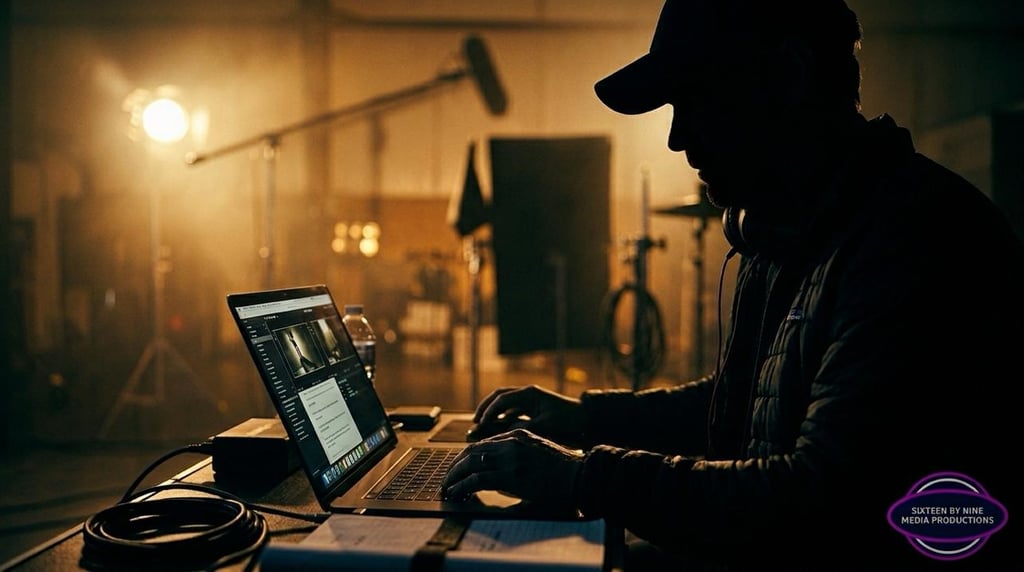

Social media demos make AI videos look like a one-click process. Enter a prompt, get a finished video. No crew, no director, no creative team. Just a tool and an idea. This version of the workflow does not exist in professional AI video production.
This misconception is propagated mainly by social media creators showcasing isolated wins and tech platforms marketing capability rather than craft. The single great shot you see in a demo is rarely the first attempt, and almost never the only one. What is left out of the highlight reel is the directorial judgment that decided which of forty generations was the keeper, and why.
The truth is straightforward: AI video production is a powerful new medium, but the output is only as good as the creative intelligence guiding the project.
At Sixteen By Nine (SBN) Media, every AI-produced video that reaches a client passes through the same directorial filter that has shaped traditional video production for decades. The medium has changed. The craft has not.
Explore the AI Ads Made by SBN Media for Several Leading Brands in India
The Director's Role Has Moved Upstream
In traditional video production, a director makes most of their critical decisions on set. Lighting, blocking, performance, lens choice, camera movement, all of it gets shaped in real time with the crew, the cast, and the location. Though most of these aspects are planned in pre-production, they get modified or adapted in real-time to get the best possible outputs.
AI video production moves nearly all of this decision-making upstream. Composition, mood, character behaviour, environmental detail, motion, and visual continuity have to be designed before a single video is generated.
The instincts that made a director valuable on a physical set, including story sense, taste, the ability to read a frame, the discipline to know what is working and what is not, all transfer directly. They simply get applied earlier in the process, and they get applied to a generative system rather than a human crew.
Brands considering AI video production should understand this clearly. In AI video production, the director is not removed from the workflow. The director sets, oversees, and adapts the workflow to get the best output.
Why Creative Direction Matters More Than Ever
"How do your AI videos look so real?" It is the question SBN Media gets asked most often, and the answer comes down to one thing: directorial craft. Our team brings years of traditional filmmaking discipline to every AI video we produce, with a creative direction and quality control process built around the details that audiences feel even when they cannot name them: Location setting, color grading, character acting, character motion, dialogue delivery, character consistency, and location consistency.
We understand that AI models have no intention, taste, or narrative logic on their own. They generate plausible videos based on patterns. That is a different thing from telling a story. Without directorial input, AI outputs default to generic visuals. Characters behave inconsistently across shots. Locations shift in subtle ways that break believability. Motion looks technically correct but emotionally flat. Brand cues drift. The result is a video that may look impressive in isolation but feels off the moment a viewer sees more than ten seconds of it.
For marketing leaders evaluating production partners, this is the most important question to ask. Who is directing the AI, and what is their creative track record?
The Iterative Reality of AI Video Production
Anyone who has actually produced commercial AI videos knows that generating one acceptable shot can require many attempts. Sometimes five. Sometimes fifty.
Each attempt is an active creative decision. The director evaluates composition, motion quality, mood, continuity with adjacent shots, and brand alignment, then adjusts the prompt, reference images, motion guidance, or model choice. A small change in phrasing can shift the entire feel of a generation. A subtle reference swap can fix a character inconsistency that was breaking the cut.
The New Skill Set a Director Needs
The AI video director needs the foundations of traditional directing, story instinct, visual literacy, performance sensitivity, and editorial sense, plus a set of additional capabilities specific to the medium.
A working AI video director needs a deep understanding of the strengths and limitations of each AI model on the market. Different models excel at different tasks. Some handle slow, cinematic motion beautifully. Others are stronger at character close-ups, or environmental scale, or stylised aesthetics. Knowing which tool to reach for at which moment is foundational.
The AI director also collaborates closely with the creative team to develop an effective screenplay, narrative structure, shot division, and expert prompts that translate the vision onto the screen. On top of this, the director manages output quality while meeting project deadlines.
Finally, the director must understand the gap between what a tool can produce and what a client actually needs. A model can produce a striking shot that has nothing to do with the brand brief. Closing that gap is directorial work.
Making AI Videos Look Professional
The clearest indicator of directorial maturity in AI video production is whether the output looks like AI video at all. A great AI video does not announce its origins. It looks like a well-produced video that happens to have been made with AI tools.
Achieving this requires active management of character consistency, location continuity, expert AI character acting, and realistic motion. Faces have to stay the same face across cuts. Hands have to behave like hands. Lighting has to track across a sequence. Wardrobe and props have to remain stable. These are workflow considerations that AI video production has to address through directorial planning and reference discipline, the same way traditional production addresses them through continuity supervisors and script notes.
Visual continuity across multiple AI-generated shots is one of the highest skill areas in this medium. Pacing, narrative flow, and the emotional arc of a sequence are human decisions at every step.
This is the layer that separates a polished SBN Media production from the AI video work that looks recognisably AI. The tools are widely available. The craft is not.
Quality Control Is the Director's Responsibility
Not every AI output is usable. Knowing what good looks like, and why something falls short, is a trained eye built over years of watching, making, and refining videos. A junior operator can run the same model and miss the same problems a senior director would catch on the first pass.
In a working AI video production, the director decides when to accept a shot, when to iterate on it, and when to change the entire approach because the current path is not converging. This judgment cannot be automated. Models can grade their own output on technical metrics, but they cannot assess whether a shot earns its place in a story, supports a brand, or moves an audience.
This is also where many AI-first productions fail. Without a director willing to reject acceptable-looking shots that do not serve the larger work, projects ship with the first thing that almost works. The result reads as adequate. But for brand work, adequate does not make the cut.
The Bottom Line
Two productions using identical AI models will produce completely different results depending on the director behind them. One will look generic, inconsistent, and off-brand. The other will look intentional, distinctive, and aligned with the brand it was made for. The cost can be similar. The outcome is not.
Marketing managers, CMOs, and brand leaders evaluating AI video production partners should look past tool lists and demos. The right diligence questions are about directorial track record, creative process, and the team's ability to manage iteration and continuity at a professional standard.
The most valuable AI video productions being made today are the ones where human creative authority is strongest. The directors who understand both filmmaking principles and the specifics of the AI tools are the ones producing work that brands can actually use.
At SBN Media, that is exactly what we offer. AI allows us to work at a scale and speed that traditional production cannot match, while the filmmaking foundation we bring ensures that what ends up on screen is of professional quality approved by our clients.
© Sixteen By NIne Media 2024. All rights reserved.
SBN Media | AI Video Studio & Corporate Film Production – Mumbai, India
Specialized in AI-powered corporate videos, brand films, product ads, and multilingual content