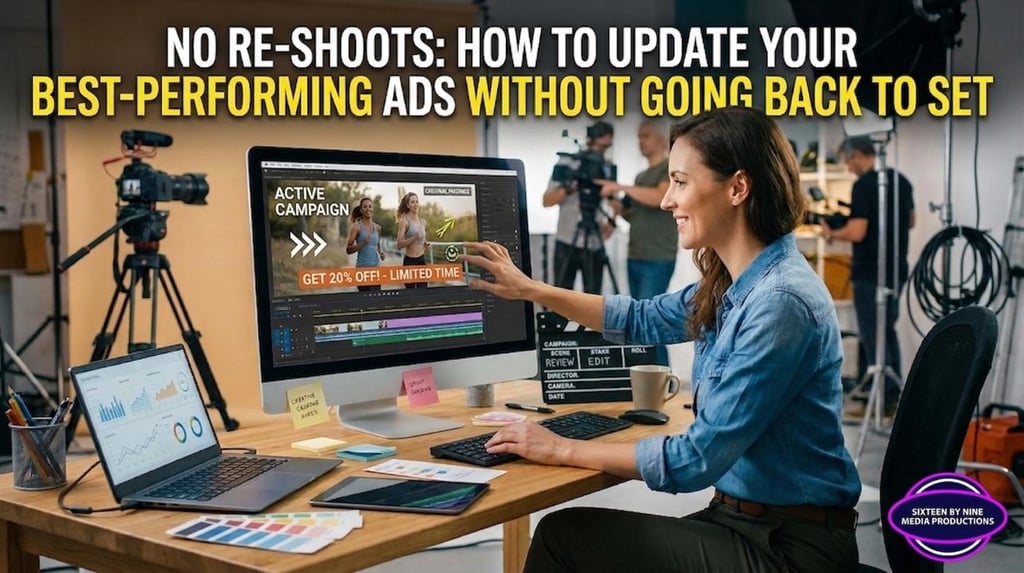
No Re-shoots: How to Update Your Best-Performing Ads Without Going Back to Set
SBN MEDIA TEAM
4/3/20268 min read

You know the pattern. A handful of creative assets drive the lion’s share of your campaign results. In fact, research from Meta's own creative teams consistently shows that top-performing ads account for the majority of conversions in any given campaign. They hit the right emotional notes, the pacing is flawless, and the results reflect it.
Then, the promotional window closes. Or a price shifts. Or a new product variant drops.
The standard industry response? Retire the winning asset. Write a new brief. Schedule a new shoot. Start from zero.
This cycle is one of the most avoidable, hidden costs in brand video production. The visual language, the talent, the location, the pacing, the emotional tone, all of that expensive creative equity evaporates the second an offer expires. For brands producing ad content at scale, the cumulative cost of this cycle across campaigns, markets, and financial years is significant. A thirty-second ad that required two shoot days, a location scout, a crew of fifteen, and four rounds of post-production doesn’t suddenly lose its effectiveness just because a promo code expired. The underlying creative still works; it just needs a layer on top of it.
The industry is finally waking up to this. Smart brands no longer treat ad production as episodic. They are approaching their best creative as a long-term asset, one that can be maintained, adapted, and extended rather than replaced. While AI video production tools have made targeted updates faster and cheaper, technology is only half the battle. The strategy behind how a video is produced, and how updates are planned and executed, matters equally.
Here is how you can systematically update your best-performing ads without ever returning to set, and the strategic foundations you need to make it work.
The Anatomy of a "No-Re-shoot" Update
Before opening your editing software, you need to diagnose the scope of the update. Not every change carries the same complexity, and the approach you take should be calibrated accordingly. We generally categorize updates into three tiers:
The Content Layer (The Quick Fix): This involves updating on-screen text, supers, offer callouts, pricing, dates, or promo codes. These are straightforward and require zero changes to the underlying footage. If you have a properly layered project file, this takes hours, not days. The most frequent mistake brands make here is failing to preserve these separated graphic layers, turning what should be a quick update into a costly rebuild.
The Audio Layer (The Sonic Shift): This means replacing or re-recording a voiceover to reflect a new message, a different language, or a revised script. This is where AI voice synthesis and dubbing have completely changed the game. Brands that previously needed to recall original voice talent, rebook studio time, and go through multiple rounds of audio sync can now handle this seamlessly with AI.
The Visual Layer (The Heavy Lift): The most complex tier involves replacing a product variant within the frame, swapping a background, or seamlessly integrating new footage. CGI and traditional visual effects have always made this kind of work possible, but historically at a cost and timeline that made it completely impractical for most update workflows. Today, AI-assisted compositing brings that capability down to a highly workable budget for a far wider range of brands.
Understanding which category an update falls into determines the workflow, the tools required, the timeline, and the realistic cost.
What AI Video Production Actually Makes Possible
AI is reshaping how we approach ad refreshes. Rather than relying on entirely new shoots, marketers can now leverage specific AI capabilities to stretch their creative budgets:
Product Swapping via AI Rotoscoping: If you shot an ad featuring last year's hero product, AI can isolate and swap it with the newest SKU. Lighting, shadow, and reflections can be matched to the original environment at a level of realism that would have required a significant VFX budget in a conventional pipeline.
Contextual Background Replacement: This has become a highly practical tool for extending the working life of content tied to a specific visual context. If a retail brand produced content with a festive seasonal environment, AI compositing can update the background setting to reflect a new campaign period while keeping the talent performance intact. Similarly, imagine a luxury car video in Germany that leads with precision engineering and performance against clean, minimalist backdrops. To launch in Brazil, the same brand shifts its visual language entirely, favoring warmer environments, family-forward scenarios, and messaging built around value. Instead of commissioning separate shoots, AI compositing can systematically swap environmental cues, producing region-specific versions from a single master creative at a fraction of the original cost and turnaround time.
Hyper-Accurate Voice Dubbing: SBN Media has worked with brands producing ad content for pan-India distribution, where the same video must work seamlessly across Hindi, Tamil, Telugu, Bengali, and other regional languages. AI dubbing tools allow a single audio track to be adapted and rhythm-matched to the original narration, bypassing the need to book separate studio sessions and different voice talent for every specific region.
B-Roll Generation and Frame Extension: Need a slightly longer cut or an extra supplementary visual to bridge a gap in the new edit? Generating new scenes that fully match the visual quality and lighting of original hero footage remains a workflow area that continues to develop. However, for supporting B-roll and cutaways, text-to-video generation is already production-ready in many contexts.
The Prerequisite: Future-Proofing Your Production
Here is the hard truth: the ability to update an ad without a re-shoot is decided on set, not in post-production. This is the most underappreciated dimension of the topic, and the one that separates brands with flexible content assets from those who find themselves rebuilding from scratch every time something changes.
The most efficient brands do not treat ad refreshes as reactive work. They plan for versioning from the moment a brief is written, and this changes how a shoot is structured from the ground up. A versioning strategy begins with a single question: what is likely to change about this ad over its intended lifespan? What happens when the current promotional offer changes? If the ad features a product at a current price point, how will it be adapted when pricing is revised? If it is currently running in one language, what is the path to multilingual deployment?
To answer those questions effectively, you have to build flexible assets on purpose. This means making tactical decisions during the shoot:
Shooting the talent against a controlled background that is easy to composite over later.
Recording additional voiceover takes at a slightly slower pace to improve future dubbing alignment.
Keeping on-screen text out of the hero footage entirely and delivering a separate, layered text file that can be updated independently of the main edit.
The shift from thinking about a single finished ad to thinking about a content system is what separates brands that spend continuously on production from those that build assets that compound in value over time. Beyond what happens on set, you must also preserve the right administrative guardrails:
Organized Source Files: Source file organization is the foundation. A flattened render is a dead end. You must retain layered project files, separated audio stems, clean background plates, and motion graphics source files.
Forward-Looking Talent Contracts: Talent appearance and contractual clearances are a production-stage consideration that surfaces frequently. If your talent release is locked to a strict seasonal window, you cannot use that footage in an updated version later. Building flexibility for derivative uses into your agreements upfront is a straightforward measure that preserves options without significantly affecting original production costs.
Ironclad Brand Documentation: Brand consistency documentation matters more than most brands realize until they need it. When updating an ad a year later, you need the exact color grading specs, font files, audio treatments, and lighting tone. Without a documented style guide or production specification sheet, maintaining visual continuity between the original and the updated version becomes a painfully expensive reverse-engineering exercise.
When a Re-shoot is Actually the Right Call
A "no-re-shoot" update strategy is a powerful framework, but it has a defined scope. There are situations where returning to production is not only appropriate but more cost-effective than forcing an update onto footage that cannot support it.
If your core creative concept is tied to a specific context that is no longer relevant, building around that constraint typically produces a weaker result than developing fresh creative. A campaign built around a specific seasonal visual theme cannot always be convincingly adapted into a different period without reworking so significantly that a new shoot would have been more efficient.
Similarly, if your brand has undergone a meaningful identity refresh, applying new visual language to legacy footage involves a series of workflow considerations that may not resolve cleanly. When a brand's new direction requires a fundamentally different narrative tone, lighting aesthetic, or talent profile, the most cost-effective and strategically correct decision is often a focused new production.
The goal isn't to avoid re-shoots categorically. The goal is to avoid unnecessary ones, and to ensure that the creative assets produced in every shoot are structured to deliver as much long-term value as possible. Every production is an opportunity to build something that works today and remains adaptable for the future.
Frequently Asked Questions
Can any existing ad video be updated without a re-shoot?
Most ads can be partially updated, but your mileage depends entirely on your source files. Videos with layered project files, separated audio stems, and clean background plates offer the maximum flexibility.
How long does a typical no-re-shoot update take?
The timeline depends on the scope of changes. Text and graphic updates can often be completed within a few working days. Voiceover replacements or AI-powered multilingual dubbing also typically take a few working days. More complex visual updates involving product replacement or background compositing may take one to two weeks.
Is AI dubbing actually suitable for brand-critical content?
Yes. AI dubbing has advanced to a point where it handles tone, pacing, and inflection beautifully. However, the best results happen when the original shoot was planned with multilingual adaptation in mind, and when native speakers review the final outputs for quality control.
What source files should I preserve from an original shoot to make future updates easier?
The most important assets to retain are layered editing project files, separated audio tracks including voiceover and music stems, clean background plates, and motion graphics source files. A production specification document covering color grading, typography, and audio treatment is equally valuable.
Does SBN Media handle existing ad refreshes?
Absolutely. SBN Media works with clients to assess existing content libraries, identify which assets have the strongest potential for update and extension, and produce refreshed versions using a combination of AI video production tools and traditional post-production techniques.
Stop Starting Over. Start Compounding Your Creative.
The economics of ad production have shifted in a way that makes the old approach increasingly difficult to justify. Brands that will hold a competitive advantage in video marketing are not necessarily those with the largest production budgets, but those that build the most intelligent content systems. A high-performing ad should not always be considered as a finished asset. It can be a foundation that can be updated through targeted, informed changes.
AI video production tools have made this practice more affordable and more technically precise than at any previous point in the industry's history. But the tools are only as effective as the strategy behind them. The brands that extract the most value from this approach are the ones that plan for adaptability from the first line of the brief, structure their shoots with future versioning in mind, and maintain the asset archives that make updates fast and consistent.
SBN Media's position in this space is grounded in over a decade of production experience combined with expert knowledge of where AI video production tools deliver genuinely reliable results. We understand both what makes a video perform and what makes it updatable.
Work with SBN Media to build ad content that performs today and adapts for tomorrow. Whether you want to refresh an existing campaign or produce new content with versioning built in from the start, our team will show you exactly what is possible with your current assets. Get in touch to start the conversation.
© Sixteen By NIne Media 2024. All rights reserved.
SBN Media | AI Video Studio & Corporate Film Production – Mumbai, India
Specialized in AI-powered corporate videos, brand films, product ads, and multilingual content