What Is an AI Hybrid Video and Why Are Big Brands Choosing It?
SBN MEDIA TEAM
3/23/20269 min read
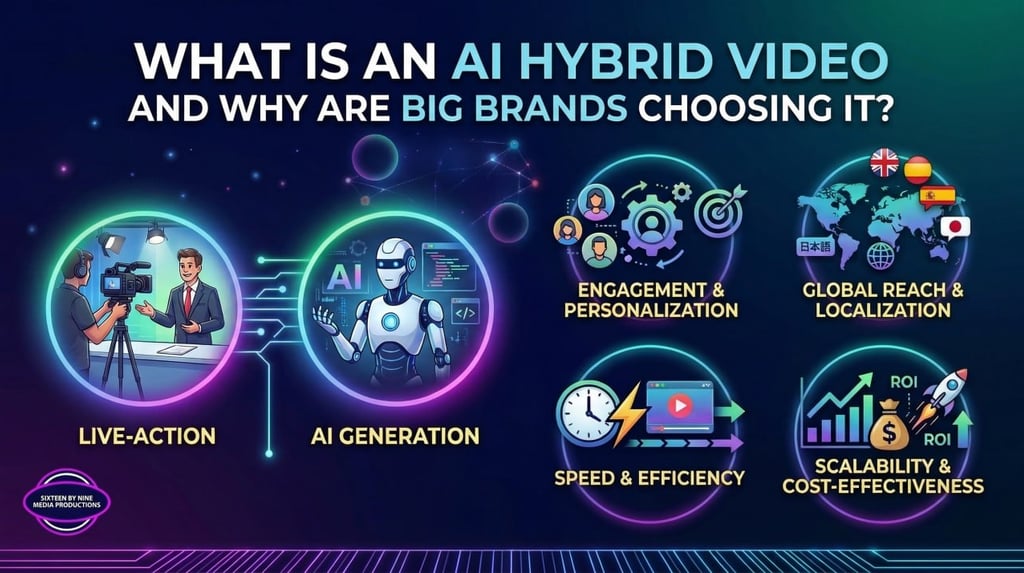
There is a category of video content that has been quietly changing how brands communicate complex ideas. It does not rely entirely on a production crew. Neither does it rely entirely on AI video production. It brings both together in a single, seamlessly integrated production, and the results are changing what marketers consider possible within a reasonable budget and timeline.
This is AI hybrid video, and the brands investing in it are not doing so as an experiment. They are doing so because it solves problems that traditional production and video production using generative AI tools have each struggled to solve on their own.
This article explains what AI hybrid video is, how it works, why the format is gaining serious traction among branding and marketing teams, and what the production process actually looks like when done well.
What Is an AI Hybrid Video?
An AI hybrid video is a format that intentionally combines two distinct types of visual content: live-action footage and AI-generated visuals.
The live-action component provides authenticity. Real people, real locations, real products, and real environments carry a credibility that AI videos cannot fully replicate. Viewers trust what they can recognise as physically real.
The AI-generated component provides capability. It allows a production team to show what a camera cannot see: internal mechanisms, invisible processes, ideal scenarios, underground systems, atmospheric phenomena, and product assembly sequences that would otherwise require an active construction site, a controlled laboratory, or a CGI studio billing by the hour.
The defining quality of an AI hybrid video is that neither component is filler. Both are doing specific, strategic work that the other cannot do as effectively. When these two elements are integrated well, the viewer experiences a single coherent narrative without noticing the transition between what was filmed and what was generated.
At Sixteen By Nine (SBN) Media, this is the standard we hold our AI hybrid productions to. The seam between real and AI-generated should be invisible. The story should feel unified.
Why Traditional Production Alone Has Limitations
To understand why AI hybrid video exists and why it is growing in popularity, it helps to understand the specific limitations of traditional live-action production when applied to complex or technical subjects.
For brands selling products or services where the most important value is invisible, this is a significant constraint.
Consider a pharmaceutical brand that wants to show how its drug interacts with cellular structures. A manufacturing company that wants to show what happens inside a sealed machine during operation. A fintech platform that wants to visualise the data flows that make its product work. All of this is possible with traditional CGI. Detailed, accurate, and visually compelling, CGI can render what no camera can reach. But production is expensive, timelines are long, and for most mid-sized companies, the cost has historically made it out of reach.
In each of these cases, live-action footage tells part of the story. The invisible, the internal, and the microscopic cannot be filmed. Traditional CGI could bridge that gap, but the cost and production time made it a tool reserved for the largest budgets. AI-generated visuals change that. The same depth of explanation is now achievable at a fraction of the cost and timeline.
Why Combining AI Visuals with Live Footage Makes for a More Complete Video
On the other side, fully AI-generated video solves the visibility problem but introduces a credibility gap.
When a brand needs to show its actual manufacturing facility, feature an interview with its leadership, or document a real process on the ground, an AI-generated video is not the right tool. Footage of a real plant, a real team, or a real product in operation carries a level of credibility that no generated visual can replicate. Audiences recognise authenticity. A procurement manager visiting a supplier's website, an investor evaluating a company before a meeting, a customer deciding whether to trust a brand, these people respond to what is real. An actual facility walkthrough, a candid leadership interview, or a documented case study on location builds the kind of trust that AI visuals simply cannot substitute.
AI hybrid video resolves both constraints. The live-action component provides credibility and authenticity. The AI-generated component provides the explanatory capability. Together, they produce something that neither could achieve as effectively alone.
The Strategic Logic Behind AI Hybrid Video
The brands choosing AI hybrid video are doing so for three consistent reasons, and these map directly to what marketing and production teams are held accountable for:
Speed to market: Traditional production timelines for a complex commercial with technical visualisation can run from four to eight weeks or longer when CGI rendering is involved. AI hybrid video, using generative AI rather than traditional CGI, compresses this dramatically.
When SBN Media produced the Waaree Radiance Solar Kit campaign for Waaree Energies Ltd., the AI hybrid workflow reduced a production that would traditionally have taken three to four weeks down to three to four days from shoot completion to first draft delivery. The live-action segments were filmed in a single day on location in Nagpur. The installation sequences, component animations, and invisible-process visualisations were generated using AI models trained on the actual product assets captured during that same shoot day.
Budget efficiency: The cost reduction in AI hybrid video is frequently misunderstood. It is not about reducing quality. It is about eliminating logistical costs.
Traditional production of technical content carries significant hidden costs: transporting large crews and equipment to remote or restricted locations, coordinating with engineering teams to access active installation sites, waiting on weather and light conditions, and paying CGI studios for render time. AI hybrid video replaces these cost centres with a leaner, more agile workflow. The brands that shift to AI hybrid video are not spending less on quality. They are spending less on logistics, and reallocating that budget toward media buying and campaign distribution, which is where it generates the most return.
How AI Hybrid Video Works: The SBN Media Workflow
The effectiveness of an AI hybrid video depends almost entirely on how the live-action and AI-generated components are planned in relation to each other. This is not a post-production decision. It is a pre-production decision, and it shapes every subsequent stage of the project.
Here is the workflow SBN Media used for the Waaree Radiance Solar Kit campaign, which serves as a practical model for how AI hybrid video functions at a professional level.
Watch Waaree Radiance Solar Kit Video: https://youtu.be/FbrMy_PfI70?si=kS3V2zsKbluMRzEf
Screenplay and narrative architecture: The process begins with a script built around a clear problem-solution arc. For the Waaree Radiance Solar Kit campaign, the problem was component confusion, as well as the multiple-vendor complexity that overwhelms a homeowner while buying a rooftop solar system. The solution was the Waaree Radiance Solar Kit: one package, one partner, one point of accountability. Every visual decision that followed served this narrative.
Host selection and trust anchoring: AI hybrid video is not a replacement for human presence on screen. For high-consideration purchases, a real person plays a critical credibility role that AI-generated imagery cannot replicate. SBN Media worked with Waaree to select a host who could communicate as a consultant and guide rather than as a performer, grounding the technical content in a human voice.
Strategic asset capture during the live shoot: This is the step that separates a well-planned AI hybrid video from one that struggles in post. During the Nagpur shoot, the production team captured not only the footage needed for the edit but also high-resolution photography and video of every product component from every angle. This material was not for the edit. It was training data for the AI models that would generate the synthetic sequences.
AI model training on actual product assets: Using the component footage captured on set, SBN Media trained AI models specifically on the Waaree Radiance Solar Kit. This ensured that every AI-generated shot of the product reflected the actual product accurately, with correct proportions, materials, colours, and branding. This step is what allows AI hybrid video to maintain brand fidelity in generated sequences, something that generic AI tools cannot guarantee.
Sequential generation and integration: With trained models in place, the team generated static images of the components first, perfecting lighting, texture, and angle before moving to motion. Video sequences were then generated from those approved statics. This included the installation process, component assembly visualisations, and the use-case demonstrations for features like the lightning arrestor and bifacial panel operation.
Seamless editorial integration: The final stage brought the live-action footage and AI-generated sequences together in the edit. The transitions between real and AI-generated visuals were designed to be invisible, serving the narrative flow rather than drawing attention to the production method.
What AI Hybrid Video Communicates About a Brand
Beyond the functional advantages of speed, cost, and visual capability, AI hybrid video carries a signal value that matters in competitive markets.
When a brand invests in AI hybrid video, it communicates that it takes its product communication seriously enough to show, not just tell. It demonstrates technical sophistication without requiring a significant budget. And it positions the brand as one that understands the gap between what a standard video can convey and what a thoughtfully engineered AI production can achieve.
In sectors where the product is complex and consumer trust is hard-won, this positioning matters. Waaree Energies operates in a market where a homeowner is being asked to make a 25-year infrastructural commitment to their most valuable asset. The quality and clarity of the brand's communication directly influences that decision.
The same logic applies across industries. MedTech brands explaining implantable devices. Engineering companies demonstrating machinery. Financial platforms visualising data security. Manufacturing brands showing the interior of a sealed process. Any brand whose most important value proposition exists beyond the reach of a standard camera has a direct use case for AI hybrid video.
Which Brands and Sectors Are Best Suited to AI Hybrid Video?
AI hybrid video delivers its strongest results in sectors where at least one of the following conditions applies:
The product or service involves processes, mechanisms, or features that are invisible to a camera.
The ideal scenario for demonstrating the product is difficult, expensive, or logistically complex to film live.
The brand needs to communicate technical credibility while maintaining emotional warmth and human connection.
The production timeline or budget does not support traditional CGI or multi-week shoots.
Sectors where SBN Media sees consistent demand for AI hybrid video include renewable energy, healthcare and MedTech, manufacturing and industrial equipment, fintech and enterprise software, infrastructure and real estate, and consumer technology.
Frequently Asked Questions
What is the difference between an AI hybrid video and a standard animated explainer video?
An AI hybrid video includes real live-action footage combined with AI-generated sequences. A standard animated explainer is entirely synthetic. The live-action component in an AI hybrid video provides a credibility anchor that animation alone cannot deliver.
How long does an AI hybrid video take to produce?
With SBN Media's workflow, a long-form AI hybrid video can move from brief to first draft in as little as two weeks, including scripting, the live shoot, AI model training, and editorial integration. Shorter formats can be delivered faster.
Is AI hybrid video more cost-effective than traditional TVC production?
For technically complex content, yes. AI hybrid video eliminates the logistical costs associated with CGI studios and complex live-action shoots in restricted or unpredictable environments, while delivering comparable or superior visual quality for the specific content type.
Can AI hybrid video maintain accurate product representation in the AI-generated sequences?
Yes, when the AI models are trained on actual product assets rather than generic references. SBN Media's workflow captures high-resolution product footage during the live shoot specifically to use as training data, ensuring brand and product fidelity in every generated frame.
Does AI hybrid video work for B2B marketing or only B2C?
AI hybrid video is highly effective for both. The Waaree Radiance Solar Kit campaign was a B2C application. The same approach applies directly to B2B contexts, including large-scale EPC project visualisation, manufacturing process demonstration, and enterprise software communication.
How does the integration between live-action and AI-generated footage appear to the viewer?
When planned and executed correctly, the transition is invisible. The production is scripted so that each visual type does the work it is best suited for, and the editorial integration is designed to serve the narrative rather than highlight the production method.
What should a brand prepare before commissioning an AI hybrid video?
The most important input is clarity on the core message and the specific visual problem to solve. What does your product do that a camera cannot show? What objection does a viewer hold that a visual demonstration could resolve? These questions drive the AI hybrid strategy.
How does SBN Media approach an AI hybrid video brief?
We begin with a strategic session focused on the narrative, the visual problem, and the audience objections the video needs to address. From there, we develop the script and visual strategy simultaneously, since in AI hybrid video, what you write and what you can generate must be planned together from the start.
Conclusion
An AI hybrid video is not a workaround for brands that cannot afford a full production. It is a deliberate format choice made by brands that want to communicate more than a camera alone can show. It combines the trust that live-action footage carries with the explanatory power of AI-generated visuals, and when the two are planned together from the brief stage, the result is content that is faster to produce, more cost-efficient, and more capable of driving genuine audience understanding than either format could achieve independently.
At SBN Media, we produce AI hybrid videos for brands across renewable energy, healthcare, manufacturing, fintech, and consumer products, spanning live-action, AI generation, motion graphics, and animation.
If you are planning a video for a product or service where the most important value exists beyond what a camera can capture, start a strategy conversation with the SBN Media team before committing to a single creative decision.
© Sixteen By NIne Media 2024. All rights reserved.
SBN Media | AI Video Studio & Corporate Film Production – Mumbai, India
Specialized in AI-powered corporate videos, brand films, product ads, and multilingual content