What Most Marketing Teams Never Hear About AI Video Production
Veo 3.1 vs Seedance 2.0 vs Kling 3.0: Why Professional AI Videos Are Never Made With Just One Model
SBN MEDIA TEAM
5/29/20265 min read
Most marketing teams assume AI video production means one platform, one workflow, one output. And a lot of vendors quietly encourage that belief because it's simpler to explain.
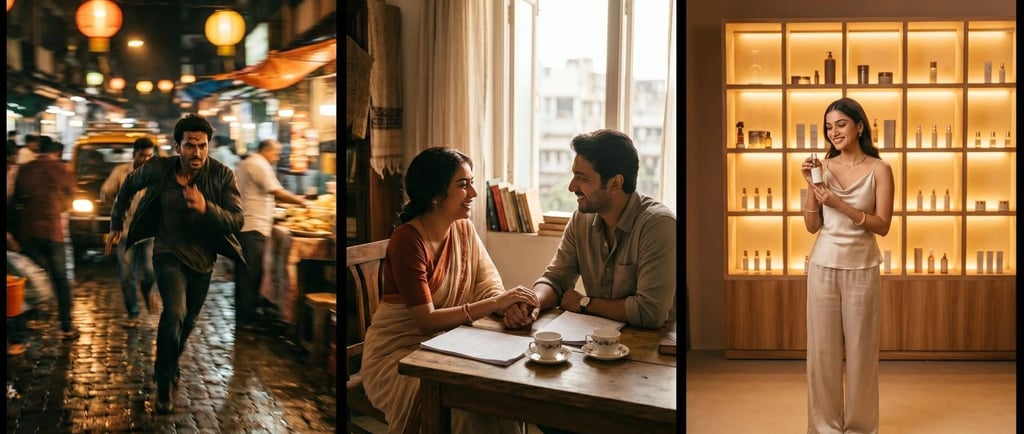
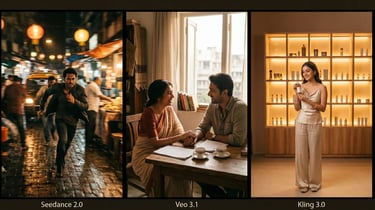
But here's the thing. Leading AI video models, specifically Google Veo 3.1, Seedance 2.0 by ByteDance, and Kling 3.0 by Kuaishou, don't all do the same things. They were built with different architectures, trained on different data, and optimized for different kinds of output.
An AI video production partner who's running everything through a single model isn't optimizing for your project. They're optimizing for their workflow. And that's a distinction worth understanding.
Explore the AI Ads Made by SBN Media for Several Leading Brands in India
What Each Leading AI Video Model Actually Does Best
On a recent production that involved action sequences, the production team at Sixteen By Nine (SBN) Media used Veo 3.1 for the majority of the project, including dialogue and production-grade shots. For specific action sequences requiring realistic physical motion and dynamic action, Seedance 2.0 was the stronger choice. We refined the prompts, worked with reference images, and the final shots delivered exactly what the scene needed.
We could effectively execute this because our team has a deep understanding of the strengths and weaknesses of different leading AI video models. Also, we use an expert, multi-model workflow to execute AI video projects because it is the most efficient and sure shot way to deliver professional results to clients.
Explore the different video production services offered by SBN Media
Google Veo 3.1: Cinematic Production and Narrative Control
Veo 3.1 is where you start when the output needs to look like it came off a professional production set.
Its strength is in close-up surface detail and complex lighting. Material textures, skin tones in close-up, reflections, shadows: Veo 3.1 renders these with a level of fidelity that's genuinely hard to distinguish from live-camera footage. If you want a product shot that looks premium, or a dialogue scene that feels human, this is the model doing the heavy lifting.
Character and location consistency are strong across multi-scene projects. Your lead character looks like the same person in scene one and scene six. Your brand environment stays coherent across cuts. That's not a given across all AI video tools, it's a specific Veo 3.1 strength.
Then there's the Google Flow editor. And this is worth spending a moment on because it changes what "AI video production" actually means. Flow isn't just text-to-video or image-to-video. It's a professional AI studio where you can build scenes sequentially, upload reference assets as "ingredients" or “frames,” define camera paths, and extend clips with narrative continuity. It's closer to actual directing than prompt writing. For studios doing complex, multi-scene brand productions, that kind of control matters enormously.
Veo 3.1 also generates native audio automatically: background music, ambient soundscapes, dialogue. That's one fewer post-production pass.
What Veo 3.1 is the right call for: Cinematic brand films, dialogue-driven content, product close-ups, location-consistent multi-scene narratives, and productions that need the Google ecosystem integration for enterprise workflows.
Seedance 2.0: Physics, Motion, and Multi-Shot Consistency
Seedance 2.0 is ByteDance's entry into professional AI video, and it earns its position at the top of the field.
Where Seedance genuinely separates itself is in physics and motion. Large-scale, dynamic, real-world physical events involving fast-moving objects, impacts, water, fire, and explosions: this model renders them with a convincing weight and realism that other models approximate but don't quite match. It's the benchmark for natural human movement too. The way a person walks, turns, reacts physically. Seedance gets the motion right.
Seedance also allows multimodal input at a level that's currently unmatched: up to 12 assets in a single generation, combining images, video clips, and audio files together. For productions working from client reference materials, this kind of flexibility changes the efficiency of the whole workflow.
And multi-shot character consistency across entirely different scenes and camera cuts is a specific Seedance strength. It keeps faces, wardrobe, and lighting aligned across the whole sequence.
What Seedance 2.0 is the right call for: Action sequences, dynamic physical motion, complex multi-shot narratives with consistent characters, productions working from multiple reference assets.
Kling 3.0: Commercial Polish, Lip-Sync, and Native 4K 60 FPS Output
Kling 3.0 by Kuaishou generates native 4K output at 60fps. That alone sets it apart for clients who need high-resolution output without running a separate upscaling workflow or dealing with the artifacts that come with it.
But the capability that makes Kling 3.0 particularly powerful for brand video is its Omni Native Audio mapping. It doesn't just sync lips to a track. It maps text to specific on-screen characters, handles phoneme-level lip-sync, and manages code-switching between different languages and dialects. For a brand running multilingual campaigns across different markets, or any spokesperson-driven video that needs to hold up to close inspection, this is a capability that changes what's possible without adding cost or time.
Kling 3.0 also includes a Multi-Shot AI Director feature that lets production teams storyboard different camera angles, lenses, and transitions from a single prompt. That compresses timelines meaningfully during the pre-production phase.
What Kling 3.0 is the right call for: High-resolution commercial output, multilingual brand videos, and spokesperson content with precise lip-sync.
Why Tool Access Alone Doesn't Produce Professional Results
Here's the honest version of what separates a professional AI video studio from enthusiasts with subscriptions to different models.
Anyone can sign up for Veo 3.1 on Google AI Studio, create an account on Higgsfield to access Seedance 2.0, and open Kling AI Studio. The tools are available. That's not the differentiator.
The differentiator is knowing which model to deploy, for which shot type, at which stage of a project, with what prompting strategy, using which reference inputs, iterated how many times before the shot is right.
That knowledge comes from running actual productions. From testing models against real briefs, not benchmarks. From learning, through iterative trial, what each model produces when the prompt is slightly different, the reference image is more specific, or the camera instruction is reframed.
What you're really commissioning when you hire an AI video production partner isn't software access. It's the accumulated production intelligence that tells them exactly when to switch tools and how to make the transition invisible.
How SBN Media Approaches Multi-Model Production
SBN Media has been producing videos for brands since 2010. Our AI production workflows running today are built on a foundation of traditional filmmaking craft, combined with deep, hands-on experience across the leading AI video models.
We don't start a project with a model. We start with your brief. Model selection happens after we understand the shot types, the tone, the consistency requirements, and the production goals. Then we make deliberate decisions about which tool handles which phase of the project, how reference assets are built, and how iterations are structured to reach the output quality your brand needs.
Our clients span manufacturing, renewable energy, retail, FMCG, healthcare, and fintech. The category changes. The production discipline doesn't.
Frequently Asked Questions
Which AI video model is best for brand video production in 2026?
There's no single best model. Veo 3.1, Seedance 2.0, and Kling 3.0 each lead in different areas. Veo 3.1 excels at cinematic lighting and dialogue. Seedance 2.0 leads on physics and dynamic motion. Kling 3.0 is strongest for commercial-grade lip-sync and native 4K output at 60 FPS. Professional productions use all three based on shot requirements.
What is a multi-model AI video workflow?
A multi-model AI video workflow is a production approach where different AI video models are used for different shot types within the same project, based on each model's specific strengths. This approach delivers higher quality output than relying on a single model for every scene.
How is professional AI video production different from using AI video tools directly?
Professional AI video production involves expert workflows, prompt engineering, reference-image curation, iterative refinement, and quality control across hundreds or thousands of shots. Access to tools is necessary but not sufficient. The expertise behind the workflow is what determines the final output quality.
If you're currently planning a brand film, product video, or campaign content and want to understand what a professionally executed AI video workflow looks like before you commission it, we're happy to walk you through it.
© Sixteen By NIne Media 2024. All rights reserved.
SBN Media | AI Video Studio & Corporate Film Production – Mumbai, India
Specialized in AI-powered corporate videos, brand films, product ads, and multilingual content