Why Industrial Video Production Is a Sales Tool, Not Just a Marketing One
The 7 Types of Videos Every Manufacturing Company Needs
SBN MEDIA TEAM
6/6/20266 min read
For manufacturing companies, videos are not used only for brand awareness purposes. Rather, videos act as sales compression tools. They help reduce the number of site visits, explanatory calls, and back-and-forth emails your sales team has to manage. And they give your sales team something tangible to share with procurement, technical leads, and decision-makers.
The numbers reflect this. Companies using B2B video marketing grow revenue 49% faster than those that don't. Proposals with video close at 41% higher rates. And 80 to 88% of industrial buyers watch a video before making a purchasing decision. Which means if you don't have videos to showcase in the research phase of your buyer's journey, you're not really in the running.
Explore SBN Media’s Video Offerings
The 7 Types of Industrial Videos and When to Use Each One
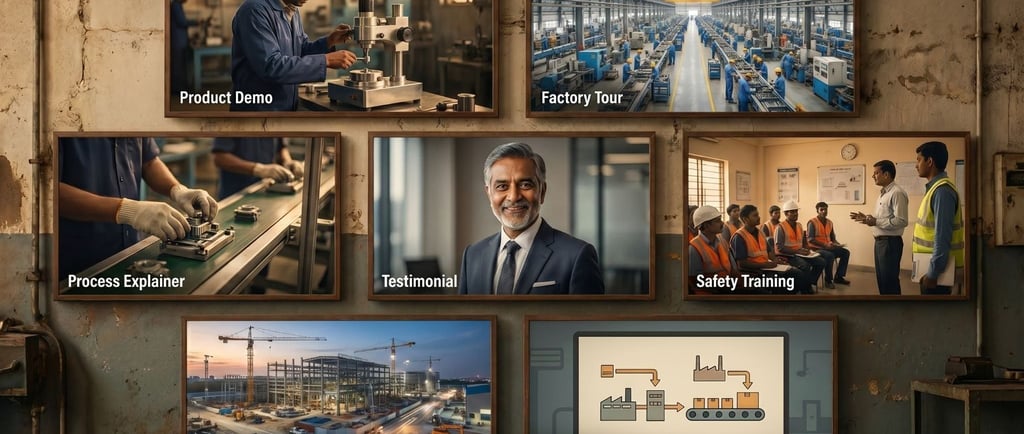
Before we take an in-depth look at the types of videos manufacturing companies need, here is a snapshot of the video types, their target audience, and when to use them.
Explore the Videos Made by SBN Media for Leading Manufacturing Companies in India
1. Product Demo Videos
A product demo video shows your machines, components, systems, or materials in operation. For a buyer evaluating your capabilities remotely, this is the closest thing to standing on your shop floor.
The best product demo videos are specific. They show tolerances, finishes, cycle times, output quality, and scale. They're narrated or captioned with technical accuracy. And they're built for the buyer's specific concern, not a generalised audience.
When to use it: On your product pages. In your RFQ responses. Shared by your sales team in follow-up emails. In your trade show booth. This is the video that does the most heavy lifting across the most touchpoints in the sales cycle.
Ideal length: 2 to 3 minutes, depending on product complexity.
2. Factory and Facility Tour Videos
A factory tour video does something almost no other marketing material can: it lets a buyer see inside your operation before committing to a site visit. For procurement teams evaluating vendors across multiple cities or states, this is enormously valuable. It answers the unspoken questions they're carrying. How large is the facility? What does the production floor actually look like? What kind of quality control setup do they have? Is this a company that takes its operations seriously?
A well-shot facility tour, with genuine production craft, good lighting, and a clear narrative structure, builds credibility in a way that a capability brochure simply cannot.
When to use it: On your website's About or Capabilities page. In your sales pitch deck. Shared ahead of buyer site visits to set context. In investor presentations. In empanelment submissions to large industrial groups.
Ideal length: 2 to 4 minutes.
3. Process Explainer Videos
If your product involves a complex manufacturing process, a proprietary technology, a specialised material, or a technical advantage that takes more than two minutes to explain verbally, a process explainer video is where that explanation lives.
The goal isn't to show everything. It's to make the right thing legible to the right buyer. A technical evaluator needs to understand how your process works and why it produces better outcomes. A procurement manager needs to understand what differentiates your approach from a competitor who's cheaper on paper. A business head needs to understand why this matters at all.
Done well, a process explainer, whether live-action, 3D visualisation, or a hybrid of both, answers these questions before they're raised.
When to use it: On product or technology pages. In proposals for technically complex solutions. In pre-sales conversations where explaining the process takes up significant time. At trade shows and industry events.
Ideal length: 2 to 3 minutes.
Read the business case for manufacturing videos
4. Case Study and Testimonial Videos
At some point in your sales cycle, your buyer stops asking "can they do this?" and starts asking "have they done this for someone like me?"
That's the moment a case study video earns its keep.
A written case study is fine. A case study video, where a real client speaks on camera about a specific outcome your work delivered, is significantly more persuasive. It's authentic. It's visual. For manufacturing companies, the most effective case study videos are specific. They show the project, the client requirement, the constraints you worked within, and the project execution and final outcome.
When to use it: In your proposals and RFQ submissions. On your website's Projects or Portfolio page. Shared by your sales team with prospects in the same sector or project type. At industry conferences and trade events.
Ideal length: 2 to 4 minutes.
5. Safety and Training Videos
These videos sit slightly apart from the others because their primary function is internal rather than sales-facing. But that doesn't make them less valuable. If anything, they're some of the highest-ROI videos a manufacturing company can produce.
Well-produced safety and training videos ensure consistent, standardised instruction across every shift, every facility, and every new hire, without depending on a single trainer to get it right every time. Research consistently shows that employees retain 25 to 60% more information from videos compared to traditional instructions. And video-based training can reduce delivery costs by around 40%.
For manufacturing operations where a missed safety step, a misunderstood lockout/tagout procedure, or an incorrectly handled piece of equipment can result in a serious incident, that retention gap isn't a small thing. Clear visual demonstrations of hazard protocols, equipment handling, and compliance procedures make the critical steps memorable in a way that a printed manual doesn't.
When to use it: New hire onboarding. Annual compliance refreshers. Rollout of new equipment or processes. Multi-site standardisation. Contractor briefings.
Ideal length: 5 to 15 minutes, often broken into modular chapters by topic.
6. Time-Lapse Videos
A time-lapse video compresses weeks or months of construction, installation, or manufacturing activity into 60 to 90 seconds of footage that communicates scale, pace, and execution capability better than almost any other format.
For manufacturing companies involved in plant construction, infrastructure installation, large equipment commissioning, or project-based work, a time-lapse is one of the most powerful portfolio assets you can build. It doesn't just tell the buyer you completed a project. It shows them the whole arc of it, from ground-level to operational, in under two minutes. These videos also are effective tools for investor and stakeholder communication.
When to use it: On your Projects or Portfolio pages. In investor and stakeholder presentations. At trade shows and industry events. In your pitch deck when project scale is a key differentiator. As a recurring content asset on LinkedIn, where time-lapse content consistently performs well organically.
Ideal length: 1 to 2 minutes as a standalone asset. Can be used as a segment within a longer corporate or case study video.
SBN Media creates Timelapse Videos for large-scale Manufacturing and Industrial clients
7. Animated Explainer Videos
Not every manufacturing concept can be filmed. Some processes happen at a microscopic scale. Some happen inside sealed systems. Some are too hazardous to document with a camera crew present. And some are better explained through clean visual abstraction than through live footage of a complex machine.
That's where animated explainer videos, whether 2D motion graphics or 3D visualisation, come in.
Animation is particularly valuable when explaining proprietary technology, internal engineering processes, molecular or structural properties of materials, or system-level concepts like how an energy storage system manages load, or how a water treatment process removes contaminants across multiple stages.
Animation also allows you to show what a finished installation or infrastructure project looks like before it's built, which is genuinely useful in pre-sales conversations and investor presentations.
When to use it: When the process can't be filmed. When the technology needs to be simplified for a non-technical audience. When you're selling a future state rather than a current product.
Ideal length: 1 to 3 minutes.
How to Decide Which Video to Make First
Here's the honest answer: it depends on where your sales cycle has the most friction.
A useful B2B video marketing strategy isn't "let's make all videos this year." It's "let's identify the one conversation that's breaking down most often, and build a video that fixes it." Start there, measure the impact, and build outward.
And if you're not sure where the friction is, that's actually a useful starting point for a conversation. Sometimes an outside perspective on your sales process surfaces the answer quickly.
Working With an Industrial Video Production Company in India
There's a meaningful difference between a generalist video production company and one that has spent years working inside manufacturing environments, understanding industrial processes, and building content specifically for technical buyers and B2B procurement cycles.
At Sixteen By Nine (SBN) Media, we've produced industrial video content for some of India's most significant manufacturing brands, including Waaree Energies, Finolex Cables, Aditya Birla Hindalco, Tata Automotive Seating, Anand Automotive, and Asian Paints, among others. We work with manufacturing brands across India, from plant floors in the western industrial belt to automotive, electronics, and energy facilities in the south.
Our work spans product demos, facility tour videos, process explainers, case study and capability showcases, animated explainers, and time-lapse production for large-scale infrastructure projects.
Your operations have more stories worth presenting to prospective clients than you probably realise. Get in touch with SBN Media today and let's discuss how to tell these stories professionally.
© Sixteen By NIne Media 2024. All rights reserved.
SBN Media | AI Video Studio & Corporate Film Production – Mumbai, India
Specialized in AI-powered corporate videos, brand films, product ads, and multilingual content