Best Use Cases of AI Videos
Why Advertising and Branded Content Are Leading the Way
SBN MEDIA TEAM
5/8/20267 min read

There is a particular version of the AI video story that gets told over and over.
It involves blockbuster visual effects. AI-generated sequences in streaming originals. The narrative is cinematic, forward-looking, and almost entirely focused on the entertainment industry.
Progress in AI video tools within film and OTT production is genuine and accelerating. But the best use cases for AI video tools right now are not in feature films. They are in advertising and marketing content.
This blog is about where AI video production is actually delivering results today, why brand advertising is the natural fit for the current state of the technology, and what marketing and business leaders need to understand before their competitors get there first.
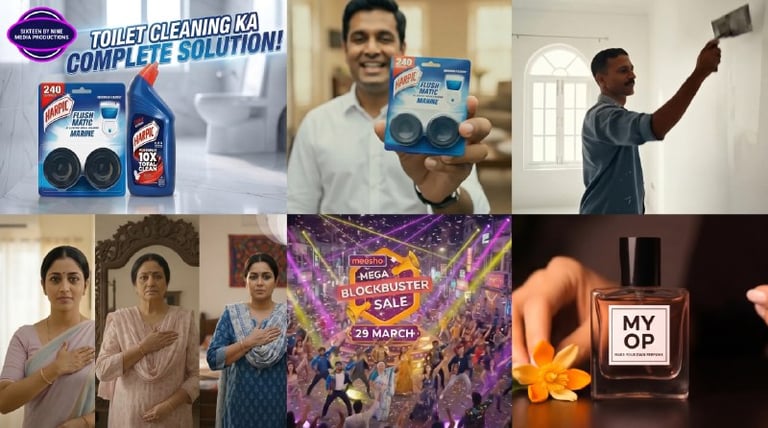
Explore the AI Ads Made by SBN Media for Several Leading Brands in India
Why Advertising Is the Natural Home for AI Video Right Now
Understanding why AI video production fits advertising so well requires a brief, honest look at where the technology currently performs best and where it is still developing.
Consider what a typical brand video or advertising campaign actually requires. A product launch film for a consumer brand runs between 30 and 90 seconds. A digital ad creative for a social media campaign might be 10 to 20 seconds. A YouTube pre-roll ad typically aims to deliver its message in the first five seconds. An explainer video for a B2B product is rarely longer than two minutes.
In every one of these formats, the production requirement is short, structured, and brief. The shot count is manageable. The narrative demands are clear. The brand guidelines provide the creative framework within which the content must sit.
This is exactly the environment in which AI video production delivers the best output.
Traditional video production has always been able to produce high-quality ad films and branded content. AI video production does not replace the creativity or craft that went into those productions. What it does is make that level of production quality accessible to a far wider range of briefs, budgets, and timelines.
Marketing managers should not fall for the lingering stigma that using AI is a "cheap" alternative, implying lower quality. AI video production is not cheaper because it is lower quality; it is cheaper because the production pipeline is fundamentally more efficient.
Favorible ROI Calculus
For businesses, the adoption of any new technology comes down to Return on Investment. With AI video in advertising, the ROI calculus is crystal clear.
Speed to Market: AI accelerates every stage, from concept development and storyboarding to video production. This allows brands to react to market trends instantly.
Cost Efficiency: By reducing the need for large crews, expensive location rentals, and specialised equipment, AI lowers the barrier to entry for high-quality video production.
Scalability and Personalisation: AI makes it feasible to create multiple variations of a single ad. Brands can change languages, backgrounds, offers, and even the on-screen characters to suit different audience segments without reshooting the commercial.
The downstream effect is significant. Budget that is freed from production cost does not disappear from the marketing function. It can be reallocated to media buying, audience targeting, platform investment, and campaign distribution. A brand that spends less on producing the same quality of content has more resources available to ensure that content reaches the right audience.
This is not a marginal efficiency gain. For brands under marketing budget pressure across competitive categories, it is a significant advantage.
Multiple Brands Are Already Running AI-Made Ad Campaigns
Sixteen By Nine (SBN) Media has produced AI ads for leading Indian brands across a diverse range of industries, including Harpic (FMCG), Zydus (Healthcare), BirlaNu (Building Materials), Reliance Smart Bazaar (Retail), Meesho (E-commerce), and La Dazzle (Home Interiors). From television commercials to digital ads to animatics, SBN Media has delivered professional results to brands with varying requirements. This extensive portfolio highlights a clear market reality: AI advertising delivers measurable results regardless of the industry and marketing requirement.
Globally, the trend is the same. Leading global brands, including Coca-Cola, Nike, Heinz, Sephora, Cadbury, and Popeyes, have successfully run AI-driven campaigns. Within a span of two years, these brands have moved beyond experimental, one-off AI ad campaigns to large-scale, high-quality AI ad campaigns with the same production value as their traditional ads.
Important Considerations for Marketing Managers and Business Leaders
The conversation about AI video production in marketing has moved past the question of whether the technology is viable. The market has already answered that question. The conversation that matters now is about how to integrate AI video production into a marketing operation in a way that produces reliable, brand-safe, high-quality output.
That integration depends on one factor more than any other: the creative and directorial judgment of the production partner behind the tools.
AI video tools are not a self-service solution that any team can operate at brand-quality levels without expertise. The output quality of an AI video production depends directly on the creative team using these tools: the brief interpretation, the prompt development, the iteration judgment, the quality control, and the post-production craft that turns generated footage into a finished brand asset.
A marketing team evaluating AI video production partners should be asking about creative track record and directorial approach, not just tool access. Two studios using identical AI tools will produce significantly different results based on the creative and directorial capability applied to those tools.
SBN Media’s AI Ad Filmmaking Workflow
You’ve seen the headlines promising that you can "create a film with a single sentence." But the reality of AI filmmaking is different. If you rely on a single prompt, you hit the wall of inconsistency: characters change faces, costumes morph, and the video feels like a disjointed fever dream.
True AI filmmaking isn't magic; it's a discipline. At SBN Media, we follow a rigid, three-part workflow that turns the chaos of generation into a consistent cinematic story.
SBN Media's AI Filmmaking Workflow
Here is a tour of how we build an AI ad film, step by step:
Part 1: The Blueprint - Lookbook and Storyboard Generation
The quality of the ad film rests on the depth of this phase, where we translate the script into a professional shot division. Based on the shot division, we first generate a lookbook (for locking the appearance of characters and locations in consultation with the client) and then move on to storyboard development.
Continuity Planning: We create detailed "Character Sheets" (defining looks, costume details, etc.) and "Location Breakdowns" (lighting, set design).
Visual Language: We define the Colour Grade and Lighting (e.g., "Chiaroscuro lighting," "Cool blue palette") to ensure that the finished ad has a cinematic and cohesive look.
Part 2: The Digital Shoot (Generations)
This is the production phase, involving a systematic process of creation and organisation. Using industry-leading AI video tools, we generate visuals based on the approved lookbook and storyboard.
The "Hero" Reference: We start by generating a master "reference image" for each character and location. This becomes the visual anchor that all subsequent shots must match.
The Prompt Lexicon: To maintain style, we create a document of core phrases and "seeds" that act as guardrails for the AI.
Text-to-Image First: We use Text-to-Image to perfect the composition and detail of a shot. Once approved, we use Image-to-Video models to impart specific, controlled motion, ensuring the performance is exactly what the director intended.
Part 3: The Final Assembly (Editing)
This phase mirrors traditional post-production but with a unique AI advantage: the "Regeneration Loop."
First Assembly & Regenerations: We lay out the approved clips on a timeline. If a shot doesn't cut together well or lacks the right emotion, the editor doesn't just cut around it. We send it back for "regeneration." We iterate until the shot fits the narrative flow perfectly.
Audio Integration: We layer Voice-overs (VO) and Sound Effects (SFX) early in the rough cut.
Final Polish: The process concludes with sound mixing and final colour grading to ensure an immersive experience.
This workflow proves that AI is not the director; it is a powerful assistant. The creative vision, emotional storytelling, and rigorous planning remain fundamentally human.
The Bottom Line
We are operating in an economic environment where marketing budgets are under intense pressure across almost every sector. Boards are demanding higher ROI, faster turnarounds, and more content across an ever-expanding list of advertising channels. Doing more with less has become the default mandate for marketing departments globally.
When it comes to AI ads, the production economics work. The quality output is commercially viable. The market evidence is real. The range of applicable content formats covers the majority of what marketing functions produce on a regular basis.
For marketing managers and senior business leaders, the relevant action is not to wait and watch. It is to identify the content requirements in your current marketing calendar where AI video production applies, find a production partner with the creative depth to execute at the quality level your brand requires, and build the institutional knowledge that will compound into a sustainable production advantage.
Frequently Asked Questions
Are AI-generated ads cheaper than traditional production?
Yes. By reducing the need for physical shoots, large crews, and lengthy post-production, AI video production can offer cost savings of up to 60% compared to traditional methods. But it is important to note that budgets may vary based on the specific requirements of the ad campaign.
Do AI-generated videos look fake or low quality?
Not anymore. Advanced AI video models like Google Veo and Kling can produce photorealistic, cinematic-quality visuals. The "uncanny valley" effect common in early AI videos has largely been overcome.
Can AI maintain brand consistency across many videos?
Yes. AI models can be trained on brand guidelines, and techniques like using "Master Templates" ensure that colours, fonts, and visual styles remain consistent, even when generating hundreds of variations.
Is human creativity still necessary in AI advertising?
Absolutely. AI is a powerful tool, but it requires human direction. Creative strategy, emotional intelligence, brand understanding, and final quality control remain essential human roles in the production process. The most effective approach combines human creativity with AI efficiency.
How Can Your Brand Start Using AI Video Ads?
Whether you need a cost-efficient launch film, localised variations for a national campaign, or a quick response video for social media, the AI-first workflow makes it possible.
The future of advertising is moving fast - make sure your brand is leading the way.
Contact SBN Media today for a free AI Video Audit. We will analyse your current video content and outline a strategy to implement AI-driven production for your brand.
© Sixteen By NIne Media 2024. All rights reserved.
SBN Media | AI Video Studio & Corporate Film Production – Mumbai, India
Specialized in AI-powered corporate videos, brand films, product ads, and multilingual content