Solar B2C Marketing Made Simple: Lessons from the Waaree Radiance Hybrid AI Video
SBN Media Team
12/3/202512 min read
The global energy transition is accelerating, with India positioned as one of the largest and fastest-growing residential solar markets worldwide. For industry leaders like Waaree Energies Ltd., the potential is limitless. As the market expands, the focus is shifting decisively toward the end consumer—the homeowner ready to embrace a sustainable future.
Marketing rooftop solar to a homeowner is fundamentally different from commercial sales. It is a sophisticated lifestyle upgrade involving important decisions about safety, aesthetics, and long-term value. To connect with today's homeowners, successful solar brands are evolving their communication strategies. The new standard isn't just to explain the technology, but to simplify the decision-making process and inspire absolute confidence.
"When you are selling a technology that enhances someone’s home, the goal isn’t just generating power; it’s generating confidence. The marketing needs to make the journey seamless and reassuring. Our goal at SBN Media is to turn complexity into clarity." — Gourav Ghosh, Founder, SBN Media.
We recently proved this with our campaign for Waaree Energies Ltd. and their All-in-One Waaree Radiance Solar Kit. This project wasn't just a video; it was a strategic dismantling of consumer hesitation using a Hybrid AI (Live Action + Generative AI) workflow.
This guide is a deep dive for solar marketing executives and brand managers. We will explore the psychology of the solar buyer, the specific advantages of the Waaree Radiance Kit, the narrative deconstruction of the ad, and the 3 Critical Use Cases of AI Videos that are changing how B2C brands communicate value.
Why Good Tech Needs Better Marketing: The Solar B2C Marketing Challenge
To understand why we chose a Hybrid AI approach, we must first understand the unique friction of the residential solar market. The Indian sector is exploding, yet effective B2C marketing remains a massive hurdle. Why?
Because purchasing a solar system forces the homeowner to shift from being a simple 'consumer' to a 'project manager.'
Unlike buying standard home electronics, which are "plug-and-play," a solar system requires the homeowner to authorise a complex engineering task on their property. They aren't just buying a product; they are making a 25-year infrastructural commitment. This distinction introduces significant psychological friction.
Top Real World Examples of AI-Powered Ad Films (2025)
Why Homeowners Hesitate (The "Construction Project" Fear)
When you ask a homeowner to install solar, you are asking them to approve a semi-permanent construction project on their most valuable asset: their home. This perception introduces significant friction.
In our experience producing renewable energy advertising videos across India, we consistently observe a phenomenon we call "Analysis Paralysis."
Component Confusion: A typical homeowner is bombarded with choices. They have to select panels from Vendor A, an inverter from Vendor B, cables from Vendor C, and a mounting structure from Vendor D. They are forced to become amateur engineers.
The Compatibility Headache: Will the inverter handle the panel's output? Are the cables fire-retardant? Is the structure rust-proof? The fear of mismatching components is a major barrier.
The "Frankenstein" System: When sourcing from multiple vendors, who is responsible if something breaks? The lack of a single point of accountability creates anxiety.
The Solution: The Waaree Radiance Solar Kit
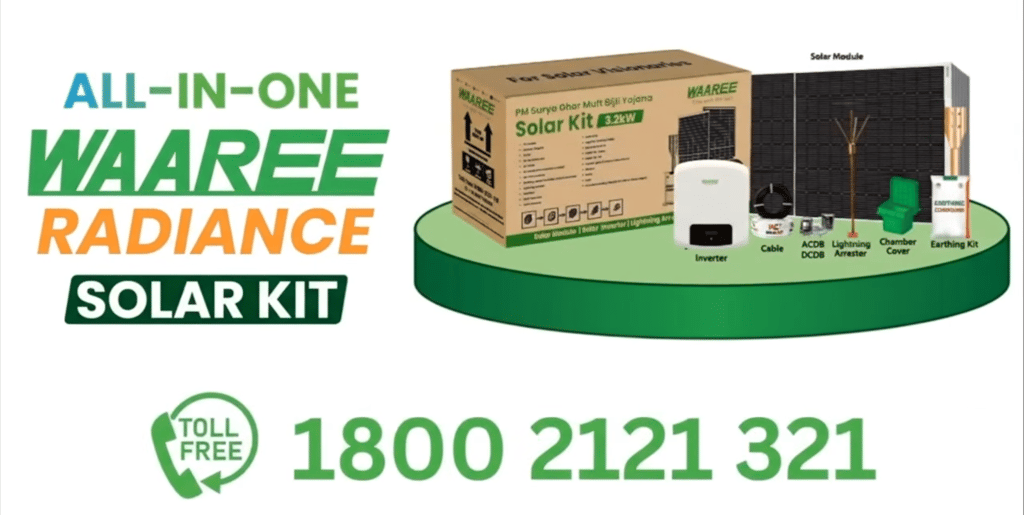
Waaree Energies Ltd. addressed this specific pain point with the Waaree Radiance Solar Kit. The USP of this product is powerful in its simplicity: It is a one-stop solution to all rooftop solar-related problems.
Unified Ecosystem: The kit solves the compatibility headache by offering every component needed for rooftop solar in one package.
Engineered Trust: Because every part is curated by Waaree, the homeowner doesn't need to worry about technical mismatches.
Expert Execution: The kit comes with installation by Waaree’s expert team, ensuring smooth operations and maximum output.
The Marketing Challenge: The "Already Finished" Dilemma
The Production Reality:
Live Sites are Unpredictable. While filming a live installation is possible, it is a logistical nightmare. Real-world construction sites are rarely "camera-ready." They are dusty, chaotic, and dependent on unpredictable variables like weather and crew availability.
To get a perfect, cinematic shot of a panel being mounted or a cable being laid, you often have to interrupt the actual engineering work. You have to ask the crew to pause, reset, or move out of the frame, which disrupts the homeowner and extends the project timeline. Furthermore, you only get one chance to capture the moment; if the light is bad or the angle is wrong, you cannot easily "redo" a permanent installation.
To film the actual installation "live" requires coordinating with engineering teams to find a site that is starting today. It requires disrupting the customer for hours, dealing with unpredictable weather, and hoping the crew installs everything perfectly on the first take. It is expensive and time-consuming.
This is where SBN Media's Hybrid AI approach became a strategic necessity.
Since we couldn't easily film the "process" live, we used AI to generate it.
Visualising the "How": Instead of waiting for a construction site, we used AI to visualise the components flying out of the box and assembling themselves.
Showing the Invisible: We didn't just show a finished project; we showed the internal safety mechanisms and current flow—things a camera could never see, even on a live site.
Perfect Execution: AI allowed us to show a flawless, rapid installation sequence that builds consumer confidence without the variables of a live shoot.
By using AI, we moved from showing a static roof to showing a dynamic solution in action.
Inside SBN Media's AI Video Studio
3 Practical Roles for AI in B2C Videos
At SBN Media, we don't use AI to cut corners on creativity; we use it to expand the boundaries of reality. Through the lens of the Waaree Radiance project, here are the three pillars of why brands are switching to AI video.
1. Less Time (The "Speed to Market" Advantage)
In the traditional ad world, a high-end commercial with complex visualisations is a multi-week, sometimes multi-month affair. Time is often the enemy of relevance in marketing.
The Traditional Bottleneck: Usually, you need to scout locations that are "shoot-ready." If you need an installation sequence, you need to coordinate with the engineering team to find a site that is currently being installed. If it rains, you lose a day. If the light isn't right, you wait. Post-production involves heavy CGI rendering, which can take weeks for a 30-second clip.
The SBN AI Advantage: With our Hybrid workflow, we compress weeks into days. For the Waaree project, the timeline was drastically accelerated.
We filmed the live segments (the host) in a single day.
Instead of waiting for a real installation to happen, we generated the installation sequences using AI.
The Result: A production that could have taken 3-4 weeks was ready for delivery in 3-4 days (from shoot to first draft).
2. Less Cost (The Economics of Efficiency)
There is a misconception that "high-tech" means "high-cost." In the case of AI video, the opposite is true. But it is important to understand how the cost is reduced. It’s not about paying people less; it’s about eliminating logistical waste.
Where does the money go in traditional production?
Logistics: Transporting large crews, heavy equipment (cranes, jibs, lighting rigs) to remote solar sites eats up the budget.
Permissions & Downtime: Getting permission to film in a high-security industrial zone or a private luxury housing society is difficult and costly.
CGI & VFX: High-quality 3D animation (CGI) is notoriously expensive. Modelling a solar inverter from scratch, texturing it, lighting it, and rendering it costs thousands of dollars per second of footage.
How AI Slashes Costs at SBN Media:
Virtual Sets & Augmentation: We don't need to build a set or find the "perfect" location. We can shoot in a "good enough" location and use AI to enhance the background, change the weather, or clean up the environment.
Generative vs. Modelled: Instead of paying a 3D artist to model a cable wire by wire, we train an AI model on the product. The AI generates the visual of the cable being laid in seconds.
Reduced Crew Footprint: Because we rely on AI for complex shots, we can shoot the live segments with a leaner, more agile crew.
The bottom line: brands get a high-quality look for a fraction of the traditional TVC budget. This allows you to allocate more budget to media buying and distribution, rather than burning it all on production.
3. Visualising the Impossible (Exact Idea + Imagination)
This is the most transformative use case. It combines two critical capabilities: putting the Exact Idea on Screen (which cameras can't see) and Visualising Tangible Imagination.
The Exact Idea + Imagination (Seeing the Invisible) Cameras capture surfaces. They see the plastic casing of an inverter or the glass of a panel. But the value of the product is often inside.
The Waaree Application: How do you show the safety aspects of the Waaree Radiance Solar Kit? We used AI to visualise the internal layers of the fire-retardant cables. We created animations showing the flow of DC to AC current inside the inverter. We didn't just show a box on a wall; we showed the technology working inside the box.
Deconstructing the Narrative (The Hybrid Advantage)
This video is a direct-to-consumer pitch. The core message champions the value of a unified approach: "Choose a complete, expert-engineered ecosystem for guaranteed performance and total peace of mind."
To communicate this effectively, we couldn't rely on live footage alone. We needed a Hybrid Model that mixes high-quality Reality with Synthetic visualisation to explain the "invisible" benefits. Here is the breakdown of that strategy:
1. Visual Breakdown: Real Footage vs. Synthetic Elements
Trust is built through reality; understanding is built through visualisation. We strategically separated these two elements.
A. Real Live-Action Footage (Building Trust):
The Anchor: The presenter on the rooftop is real. This provides the necessary human connection and authority that an AI avatar cannot yet match.
Social Proof: We used real drone shots of apartment complexes covered in solar panels. This tells the viewer, "Your neighbours are already doing this; you are missing out."
Physical Tangibility: The scenes where components (inverter, cables, earthing kit) sit on a table are real. It is crucial to show the customer that these are tangible, high-quality physical goods, not just digital concepts.
B. Synthetic, Animation & AI (Visualising Value): Some aspects of a product story simply cannot be captured by a camera lens. We utilised AI and animation to visualise the invisible and set the emotional context.
Visualising Emotion: We visualised the "confusion" of the older man, stressing over papers. This sets the emotional stage, instantly establishing the friction of "component chaos" without needing a complex set build.
Visualizing the Invisible: Features like Bifacial Gain (power generation from both sides) and Chemical Earthing (underground safety) are impossible to film on a live site. We used synthetic visualisation to create "X-ray views" of the ground and animated energy flows. This transformed abstract engineering concepts into clear, tangible benefits that any homeowner can understand at a glance.
The "Ideal" Installation: Instead of relying on the unpredictability of a live construction crew, we utilised AI to visualise the installation team. This allowed us to depict men in pristine Waaree uniforms with perfect safety gear, establishing a standardised image of professionalism and safety that frames the brand as an industry leader.
2. Strategic Objection Handling
The script was structured to systematically dismantle the four biggest objections holding a homeowner back.
Objection 1: "It's too complicated to choose parts."
The Solution: The "All-in-One Kit." We used a 3D graphic of a box dropping to suggest that everything comes in one simple package. Chaos becomes order.
Objection 2: "Will it generate enough power?"
The Solution: We highlighted the Bifacial N-Type Modules. By visually demonstrating how they capture reflected light, we validated the efficiency claim. Mentioning "NABL Certified Labs" added the necessary layer of technical credibility.
Objection 3: "Is it safe? Will it cause a fire?"
The Solution: A significant portion of the video focuses on BOP (Balance of Plant) components. We leveraged AI to visualise the fire-retardant cables and simulate the lightning arrester protecting the home during a storm. This allowed us to show that Waaree cares about the "boring" but critical parts that keep a family safe.
Objection 4: "Who will install it?"
The Solution: We showcased Waaree’s own certified professionals. By zooming in on their safety gear (harnesses), we reassured the customer that the installation wouldn't damage their property or hurt the workers.
3. The Human Element: The Strategy of the Host
The Objective: To ground the high-tech production in the reality of the client site.
While AI provided the visual magic for the product demonstration, the inclusion of a host played a specific strategic role in the storytelling.
On-Site Verification: Since the live shoots were conducted at actual client sites where Waaree installations were already complete, the host acts as a "Tour Guide" to reality. Their presence validates that the digital dream shown at the start is a tangible reality for these homeowners.
Clarity of Communication: The host serves to translate technical details into conversational benefits. They guide the viewer through the journey, bridging the visual transition from the AI-enhanced sequences back to the physical installation environment.
Summary: Why This Approach Works
By combining the authenticity of live shoots at client sites with the limitless visualisation capabilities of AI, the Waaree Radiance ad successfully communicates a complex value proposition:
Simplicity: It solves the headache of mixing components.
Trust: It highlights Waaree’s quality and expert installation.
Aspiration: It sells the dream of a powered, autonomous future.
The SBN Media Hybrid Workflow (13 Steps)
For the marketing executives and production teams reading this, theory is good, but execution is everything. Transparency is part of our authority. Here is the exact, step-by-step 13-point workflow SBN Media used to deliver the Waaree Radiance Solar Kit campaign.
1. Screenplay Development: We started with the brief. We developed a screenplay based on the "Problem-Solution" arc. We identified the villain (Confusion/Multiple Vendors) and the hero (The Waaree Radiance Kit). The script was written in "Hinglish" to ensure it felt native and relatable to the Indian middle-class homeowner.
2. Host Selection (The Trust Anchor): A purely AI video can feel cold. To sell a high-ticket item like solar, you need a human face. We provided Waaree with a list of professional anchors to select from. We needed a host who communicated clarity and trust—someone who could act as a "consultant" rather than just an actor.
3. The Live Shoot (Nagpur): We travelled to Nagpur to shoot at real locations—a bungalow and a housing society. We filmed the Mumbai-based anchor on location, along with all the actual components. This grounded the video in reality.
4. Strategic Asset Capture: This is where our workflow diverges from traditional production. While on set, we didn't just film the ad. We captured high-resolution photos and videos of every single component (panels, inverters, mounting kits) from every angle. This wasn't for the edit; this was training data for our AI.
5. Editorial Line-up: Back in the studio, we lined up all the shots of the anchor according to the script on the editing timeline. This created the "skeleton" of the narrative.
6. AI Model Training (The "Secret Sauce"): We took the component footage from Step 4 and trained AI models on the Waaree Radiance Solar Kit components. This taught the AI exactly what "Waaree" looks like, ensuring 100% brand fidelity in generated shots.
7. Image Recreation: We used the AI to recreate the shots of the components as static images first. This allowed us to perfect the lighting, texture, and angles without changing the products or the branding.
8. Video Generation: From those perfect images, we generated video sequences. This included the installation process—visuals of mounting structures being aligned and panels being secured—which we could not film live because the sites were already finished.
9. New Use-Case Generation: We generated new video shots as per the specific use cases of the components (e.g., showing how the lightning arrestor works during a storm). These were shots that would be impossible or dangerous to film live.
10. Seamless Integration: Our editors seamlessly integrated the shot material (the host) along with the AI-generated material (the tech demos) in post-production. The transition between "Real" and "AI" was made invisible to the viewer.
11. Technical Supers: We worked closely with the client to add the correct technical specifications in the supers (on-screen text). This ensured compliance and education.
12. Localisation Prep: We finalised the master video with subtitles and resizing for various formats. The video is now structured to be dubbed into multiple Indian languages for a Pan-India reach.
13. Micro-Content Creation: Finally, we are carving out multiple "Shorts" and "Reels" from the master footage, creating specific clips for each component (e.g., a 15-second clip just on the inverter) for targeted digital ads.
SBN Media's AI Filmmaking Blueprint
FAQs for Solar Marketing Executives
We frequently receive these questions regarding an AI-generated commercial for a solar company and our production process.
Q: How do AI-generated commercials help visualise complex installations?
A: AI visualisation allows us to show processes that might not be available to film live, such as a completed installation or the internal workings of technology (like the Bifacial panel animation). It ensures we can tell the complete story, from setup to operation, with absolute accuracy.
Q: What are the advantages of Hybrid AI vs traditional video?
A: Hybrid AI offers superior speed, accuracy in product visualisation, and cost effectiveness for complex scenarios. It allows for visualisations that are impossible or prohibitively expensive to film traditionally.
Q: What is the typical timeline for solar film production using this method?
A: A long-form explainer video utilising a hybrid workflow can be completed very rapidly. A production like the Waaree Radiance Solar Kit video typically takes 2 weeks from initial brief to delivery of the first video draft, including scripting, the live shoot, AI model training, visual generation, and editing.
Q: How accurate is the AI visualisation?
A: The accuracy is exceptional because we train the AI models on real hardware. For the Waaree project, we used high-resolution footage of their actual components to train the models, ensuring perfect representation.
Q: Can this approach be used in B2B EPC marketing as well?
A: Yes. While this case study focused on B2C, the hybrid approach is highly effective for B2B marketing, particularly for visualising large-scale EPC projects, manufacturing processes, and infrastructure development.
Q: Can this approach work for other tech-heavy products?
A: Absolutely. This approach is ideal for MedTech, specialised engineering services, manufacturing, and enterprise software—any industry where the product is complex, or the process is difficult to visualise.
Conclusion: The Future is Clear
Effective B2C solar marketing is no longer just about generating leads; it is about reducing friction. To convince a homeowner to invest in a rooftop system, brands must translate complex engineering specifications into clear, relatable benefits. The marketing must simplify the purchasing journey, visually demonstrate value, and answer the "invisible" questions regarding safety and efficiency.
This is where SBN Media adds value. By integrating Live Action with AI and CGI, we help solar brands overcome traditional production bottlenecks.
Visualising Value: We enable you to show technical advantages—like bifacial gain or underground earthing chemistry—that cannot be filmed with a standard camera.
Speed to Market: Our hybrid workflow significantly compresses production timelines, allowing you to launch campaigns in days rather than weeks.
Budget Efficiency: By reducing the reliance on complex live construction shoots and heavy logistics, we deliver premium, high-fidelity assets that fit within competitive marketing budgets.
Your technology is advanced. Your marketing should be too.
Ready to visualise the impossible and build undeniable consumer trust?
Connect with SBN Media today. Let’s turn your complex solar solutions into a clear, compelling story that the world is ready to hear.

© Sixteen By NIne Media 2024. All rights reserved.
SBN Media | AI Video Studio & Corporate Film Production – Mumbai, India
Specialized in AI-powered corporate videos, brand films, product ads, and multilingual content