
Top Real World Examples of AI-Powered Ad Films (2025)
Achieving Speed & Scale alongside Quality & Personalisation with AI Ad Videos
SBN Media Team
11/27/202513 min read
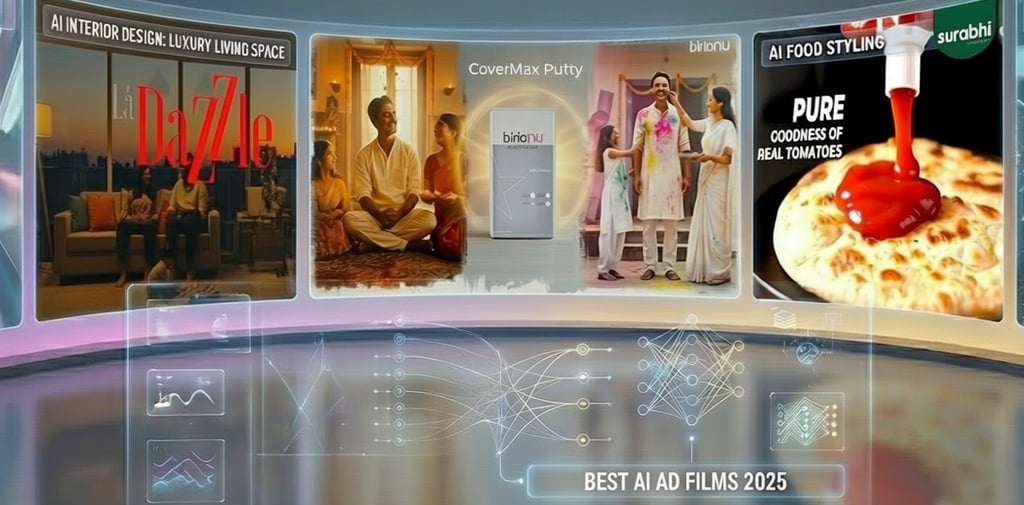
Artificial Intelligence in video advertising has moved far beyond its early days. Just two years ago, AI video was often characterised by strange artefacts, inconsistent characters, and a generally "uncanny valley" feeling. It was a novelty, used more for experimental projects than serious brand building.
In 2025, the technology has matured significantly. Tools like OpenAI’s Sora, Google Veo, and advanced versions of Runway have changed the production landscape. The focus has shifted from simply generating images to creating cohesive, emotionally resonant narratives. AI is no longer just a tool for speed; it is a creative partner capable of adding cinematic quality and depth to advertising.
This shift allows production studios to offer unprecedented speed and cost efficiency without sacrificing quality. At SBN Media, we specialise in this AI-first approach, helping brands in India and globally produce stunning ad films in days rather than weeks, often realising cost savings up to 60% compared to traditional methods.
This article examines 10 standout examples of AI-driven ad films from 2024 and 2025. We analyse how they were made and what marketers can learn from their success.
How Has AI Video Production Changed Advertising?
The integration of AI into the ad film production pipeline offers three primary advantages over traditional methods:
Speed to Market: AI accelerates every stage, from concepting and storyboarding to final rendering (using text-to-video platforms). This allows brands to react to market trends instantly.
Cost Efficiency: By reducing the need for large crews, expensive location rentals, and specialised equipment, AI lowers the barrier to entry for high-quality video production.
Scalability and Personalisation: AI makes it feasible to create hundreds of variations of a single ad. Brands can change languages, backgrounds, offers, and even the on-screen avatars to suit different audience segments without reshooting the commercial.
5 Best Corporate AI Videos 2025
The Top 10 AI-Driven Ad Films of 2025
These examples showcase the diverse ways brands are using AI video technology today, ranging from full synthetic generation to sophisticated hybrid models.
1. LaDazzle (Interior Spaces) - Crafting Aspiration with Digital Set Design
Category: Home Interiors / Modular Kitchens and Wardrobes / D2C Brand Film
The Context
The home interiors market, particularly modular kitchens and wardrobes, is driven by aspiration. Consumers are not just buying storage; they are buying a lifestyle and a status symbol. Traditionally, creating the high-end, luxurious environments needed to showcase these products required building expensive physical sets, securing exclusive locations, and managing complex lighting setups. For a D2C brand like LaDazzle, competing with the visual standards set by established luxury interior houses presented a significant budgetary challenge.
The AI Execution: The "Digital Set Extension" Workflow
SBN Media’s objective was to position LaDazzle’s offerings within an atmosphere of exclusivity and high design. We achieved this using our "Digital Set Extension" workflow, powered by AI.
The core strategy was environmental control. Instead of building physical sets, we generated hyper-realistic, perfectly designed interiors digitally. This allowed us complete control over architecture, materials, and, crucially, lighting.
We focused on achieving a consistent, sophisticated "golden hour" glow throughout the film, a look that is time-consuming and difficult to maintain in a physical shoot. The AI models excelled at rendering the specific textures critical to this sector: the subtle grain of premium wood veneers, the flawless reflection of glossy finishes, and the interaction of light with metallic handles. The result is an environment that feels expensive and meticulously curated, elevating the perceived value of the product.
The Business Impact
This campaign demonstrated that aspirational marketing in the interiors space is no longer restricted by the costs of physical production. By using AI to control the environment, SBN Media delivered a campaign with the aesthetic quality of a luxury European design house, providing LaDazzle with the visual assets needed to command a premium position in the D2C market.
2. BirlaNu CoverMax Putty: Achieving Emotional Realism with AI
Category: Construction / B2B Industrial / Emotional Brand Film
The Context
B2B putty advertising typically focuses on technical specs, lacking an emotional connection. BirlaNu sought to disrupt this by targeting their primary users: painters. The objective was to position the product's 20% more coverage feature not just as an efficiency metric, but as a way for painters to save time and reclaim lost moments with their families during festivals.
The Challenge
The concept required visualising a protagonist across multiple seasons and festivals (Diwali, Holi). A traditional shoot would involve prohibitive costs and massive crowd logistics. Furthermore, the production worked efficiently on two key AI aspects: generating genuine emotion rather than the typical "soulless" feel, and maintaining strict character consistency across different lighting and environments.
The AI Execution: The "AI Director" Philosophy
SBN Media employed a human-led "AI Director" approach to guide the technology, achieving three key technical breakthroughs:
Solving Character Consistency: To prevent facial morphing, specific AI models were trained on character references. This ensured ‘brand hygiene’ and kept the painter’s appearance consistent throughout the 66-second commercial.
Crossing the Uncanny Valley: Through expert prompting, the team focused on micro-expressions. They successfully visualised the shift from weariness to joy, allowing the audience to connect with the characters as real people.
Advanced Environmental Models: Complex, culturally rich scenes were generated digitally, bypassing physical production limits. The AI "painted with light," shifting from the melancholic tones of isolation to the warm glow of Diwali and the vibrance of Holi.
The Business Impact
The campaign set a new benchmark for the B2B sector by injecting deep human emotion into a functional product category. By leveraging AI to handle complex environments and hyper-realistic performances, SBN Media demonstrated that high-production, emotionally resonant storytelling is achievable for B2B brands without the budget and logistics of traditional filmmaking.
3. Toys“R” Us: The Origin of Toys“R ”Us (Retail/Brand Story) - Long Form Synthetic Narrative
Category: Retail / Brand Story / Animated Film
The Context
As part of its brand revival, Toys“ R” Us wanted to reconnect with audiences emotionally by telling its origin story. The goal was to create a cinematic, animated film detailing the journey of founder Charles Lazarus and the mascot, Geoffrey the Giraffe. Traditionally, this level of animation would take months and a large team of artists.
The AI Execution
This film is a landmark achievement as it was created entirely with OpenAI’s Sora, the advanced text-to-video model. The entire narrative, character designs, environments, and animation were generated synthetically. The ability of Sora to maintain character consistency and execute complex camera movements allowed for a cohesive long-form story. The ad premiered at the Cannes Lions Festival in 2024.
The Business Impact
This film serves as definitive proof of concept for long-form AI brand films. It signals a major shift in how brand histories and founder stories can be visualised without the overhead of traditional animation studios.
4. OpenAI: The Intelligence Age (Technology) - AI Assisted Ideation
Category: Technology / Brand Awareness / TV Commercial
The Context
OpenAI, the creator of ChatGPT and Sora, needed to introduce its technology to a mass market audience during the 2025 Super Bowl. The objective was to position AI as the next step in human innovation, comparable to the discovery of fire.
The AI Execution
This 60-second animated ad traced the history of human innovation. While the final visuals were created and polished by human artists, AI played a crucial role in the ideation and concept development stages. AI tools were used to rapidly explore different visual metaphors, generate storyboard frames, and test narrative structures before committing to the final animation style.
The Business Impact
This example demonstrates the role of AI as a creative collaborator at the highest levels of advertising. Even when the final output is not fully synthetic, AI accelerates the creative process, allowing teams to explore more ideas and refine concepts faster.
5. Smart Bazaar (Retail) – Achieving Content Velocity
Category: Retail / Promotional Campaign / Scaled Content & Localisation
The Context
Retail advertising is a high-velocity environment. Offers change weekly, sometimes daily. "Monsoon Sale," "Diwali Dhamaka"—the creative assets for these campaigns have a shelf life of just 48 to 72 hours. Traditionally, brands had to choose between speed (using cheap, static images) or quality (producing TV commercials that took too long). Smart Bazaar needed a high-quality video produced at the speed of social media.
The AI Execution
SBN Media deployed its "Growth & Scale" workflow for this campaign. The goal was to build a content engine. The team created "Master Templates" where AI tools could instantly swap out product images, price tags, and promotional text.
Watch All the Smart Bazaar Videos on Youtube
Crucially, this campaign used AI dubbing to handle India’s linguistic diversity. A sale announcement recorded in Hindi could be instantly versioned into regional languages without bringing the voice actor back into the studio.
The Business Impact
This case study solves the "Content Velocity" problem. It shows major retailers that they can saturate digital channels with high-quality, motion-based content that looks premium but is produced on an extremely rapid timeline.
6. Surabhi Sauces (FMCG/Food & Beverage) - Mastering Appetite Appeal
Category: FMCG / Food & Beverage / Product Ad
The Context
In food advertising, "Appetite Appeal" is the ultimate goal. The food must trigger a sensory response. Traditionally, this is very difficult to shoot. Ice cream melts under studio lights; sauces congeal; steam disappears. A typical food shoot requires a specialised "Food Stylist" and high costs just to get one perfect shot.
The AI Execution
SBN Media used the latest advancements in AI video models, which have become adept at understanding the physics of liquids and food textures. The film features rich, sensory visuals. Sauces glisten under warm light, steam rises in perfect swirls, and vibrant colours stand out on screen.
The background environment—a warm, homely dining space—was likely generated to evoke a specific emotional mood. The AI allowed the team to iterate on the "pour" of the sauce dozens of times digitally to find the most delicious look, rather than resetting a physical plate repeatedly.
The Business Impact
This approach significantly reduces the complexity and cost of food videography. For FMCG brands, this means they can create mouth-watering content for every single product in their portfolio without needing a massive photoshoot for each one.
7. Fluid AI’s French Revolution Ad (B2B Technology) - Cinematic B2B Storytelling
Category: B2B Technology / Brand Film / Conceptual Ad
The Context
Fluid AI, an enterprise technology company, needed a way to dramatise the frustration of poor customer service. B2B advertising often struggles to be memorable. Fluid AI wanted to break this mould and position its Agentic AI system as a revolutionary solution.
The AI Execution
The ad throws viewers into the middle of a French Revolution-style uprising. Crowds are shouting, chaos reigns—a powerful metaphor for the frustration of dealing with outdated customer support systems. The visual execution looks like a high-budget cinematic spot, yet it was generated almost entirely by AI. The costs were a small fraction of what a traditional production of this scale would require.
The Business Impact
Fluid AI proved that AI-generated ads are not limited to playful experiments. They can deliver big, polished storytelling that positions enterprise solutions in bold, cinematic ways. It demonstrates that B2B companies can take creative risks and achieve high-impact results with AI production.
8. Atera: IT Manager’s Dream (B2B SaaS) - End-to-End AI Production
Category: B2B SaaS / Product Marketing / Conceptual Ad
The Context
Atera, a B2B IT management platform, needed a visually engaging way to communicate the abstract benefits of its software, such as reduced stress and increased efficiency for IT professionals. They aimed for a high-concept campaign while prioritising cost efficiency.
The AI Execution
Atera created an entirely AI-generated campaign world where IT professionals live in a stress-free, automated environment. The spot used a combination of tools, including Runway, Sora for visual generation, and ElevenLabs for the voiceover. Every frame of the advertisement was generated by AI, demonstrating a complete end-to-end synthetic pipeline.
The Business Impact
This is a perfect example for B2B marketers. It shows how mid-market SaaS companies can use AI to build a rich fictional universe around abstract software products, moving beyond feature lists to emotional benefits.
9. Motorola - "Styled by Moto"
Category: Technology / Smartphone Launch (Razr 50)
The Context
To launch the Razr 50 foldable phone, Motorola wanted to position the device not just as a piece of tech, but as a fashion accessory. The phone comes in vibrant colours and unique finishes (like vegan leather), and the brand needed a campaign that highlighted this "stylish" DNA without the massive overhead of a high-end fashion shoot (which typically involves booking top-tier models, designers, and catwalks).
The AI Execution: Motorola created a "Fashion-Style" video ad entirely using generative AI.
Concept: The campaign, titled "Styled by Moto," featured AI-generated models walking a virtual runway wearing AI-generated clothing.
The Hook: The clothing wasn't random; it was specifically generated to match the texture, colour, and design language of the new Razr 50 phones.
Full-Stack AI: This was a holistic AI production—from the soundtrack to the visuals, every part of the creation utilized generative tools.
The Business Impact
Brand Positioning: This ad successfully blurred the line between Tech and Haute Couture, reinforcing the Razr 50 as a lifestyle product.
Cost & Speed: A "Global Fashion Week" aesthetic was created without flying a single model to Paris or Milan.
Creative Freedom: AI allowed the creative team to design "impossible" outfits—clothing that perfectly mimicked the phone's materials—which would have been difficult and expensive to fabricate physically for a one-minute ad.
10. Coign’s AI-Generated National TV Commercial (Financial Services) - Rapid National Deployment
Category: Financial Services / TV Commercial / Rapid Production
The Context
Coign, a credit card brand targeting conservative audiences, aimed to make history with the first fully AI-generated national TV commercial in the financial services industry. They needed a scalable, fast way to communicate their message of responsible spending habits and financial values.
The AI Execution
The 30-second spot showed AI-generated visuals of everyday Americans discussing financial values. Remarkably, the ad was produced in less than a day. This timeline is unheard of for national TV, which typically requires weeks or months of production involving actors, sets, and crews. The spot aired widely on networks including Fox News and various social media platforms, reaching Coign’s target demographic efficiently.
The Business Impact
While some critics noted the ad felt slightly less polished than traditional spots, it was groundbreaking. It served as a proof point that financial brands, among the most conservative and regulated sectors in advertising, are willing to adopt AI-generated campaigns. Coign demonstrated the immense speed advantage of AI for large-scale media buys.
Why These AI Ad Films Matter: The 2025 Impact Summary
The campaigns highlighted above are more than just creative successes; they signal fundamental shifts in the advertising production industry.
Speed Became Strategy
In the past, speed often compromised quality. Now, speed is a strategic advantage. Companies like Fluid AI and Coign proved that high-quality campaigns can be conceived and launched in days—or even hours—allowing brands to react instantly to cultural moments or market changes.
Budgets Collapsed
The cost barrier for cinematic or national TV advertising has fallen dramatically. Coign and Fluid AI delivered high-quality ads at a tiny fraction (sometimes reported as less than 1%) of traditional costs. This allows smaller brands to compete with established players and enables large brands to allocate budgets more efficiently.
Creativity Expanded
AI tools free creative teams from the constraints of physical production. We are seeing a broader range of narratives, including surreal chaos (Fluid AI), nostalgic tributes (Toys“R” Us), and visualising the invisible (BirlaNu). AI allows brands to explore unconventional storytelling, like diving to the molecular level to show product quality, which would be too expensive or complex to execute traditionally.
Mainstream Adoption is Here
AI advertising is no longer restricted to tech startups. Highly regulated image-conscious sectors like financial services (Coign) are embracing AI production. This signals that the technology is reliable and effective for mainstream brand building.
Cultural Resonance and Emotional Connection
The best AI ads of 2025 show that synthetic media can connect emotionally and not just visually. By focusing on storytelling, character development, and visual quality, brands are creating AI-generated content that resonates with audiences on a human level.
A Deep Dive into the SBN Media AI Ad Filmmaking Workflow
You’ve seen the headlines promising that you can "create a film with a single sentence." But the reality of AI filmmaking is different. If you rely on a single prompt, you hit the "wall of inconsistency"—characters change faces, costumes morph, and the video feels like a disjointed fever dream.
True AI filmmaking isn't magic; it's a discipline. At SBN Media, we don't just "wing it." We follow a rigid, three-part workflow that turns the chaos of generation into a consistent cinematic story.
SBN Media's AI Filmmaking Workflow
Here is a tour of how we build an ad film, step by step:
Part 1: The Blueprint (Screenplay Breakdown)
Everything starts with preparation. The quality of the ad film rests on the depth of this phase, where we translate a human script into a machine-interpretable plan.
The Shot List: We don't just write a scene; we break it down into a granular shot list. Each shot is assigned specific prompts to ensure cinematic coverage.
Continuity Planning: This is the biggest challenge. Since AI has no memory, we have to do the remembering for it. We create detailed "Character Sheets" (defining looks, eye colour, costume details) and "Location Breakdowns" (lighting, set dressing). These details are tracked and fed back into every prompt to ensure the characters looks the same in different shots.
Visual Language: We define the Colour Grade and Lighting (e.g., "Chiaroscuro lighting," "Cool blue palette") before a single image is generated.
Part 2: The Digital Shoot (Generations)
This is the production phase, a systematic process of creation and organisation.
The "Hero" Reference: We start by generating a master "reference image" for each character and location. This becomes the visual anchor that all subsequent shots must match.
The Prompt Lexicon: To maintain style, we create a document of core phrases and "seeds" that act as guardrails for the AI.
Text-to-Image First: We rarely go straight to video. We use Text-to-Image to perfect the composition and detail of a shot. Once approved, we use Image-to-Video models to impart specific, controlled motion, ensuring the performance is exactly what the director intended.
Part 3: The Final Assembly (Editing)
This phase mirrors traditional post-production but with a unique AI advantage: the "Re-generation Loop."
First Assembly & Re-generations: We lay out the clips on a timeline. If a shot doesn't cut together well or lacks the right emotion, the editor doesn't just cut around it—they send it back for "re-generation." We iterate until the shot fits the narrative flow perfectly.
Audio Integration: We layer Voice-overs (VO) and Sound Effects (SFX) early in the rough cut.
Final Polish: The process concludes with sound mixing and final colour grading to ensure an immersive experience.
This workflow proves that AI is not the director; it is a powerful assistant. The creative vision, emotional storytelling, and rigorous planning remain fundamentally human.
FAQs: AI Video Advertising in 2025
Are AI-generated ads cheaper than traditional production?
Yes, significantly. By reducing the need for physical shoots, large crews, and lengthy post-production, AI video production can offer cost savings of up to 60% compared to traditional methods.
Do AI-generated videos look fake or low quality?
Not anymore. Advanced AI video models like Sora and Google Veo can produce photorealistic, cinematic-quality visuals. While some stylisation is possible, the "uncanny valley" effect common in early AI videos has largely been overcome.
What are the most common AI tools used in ad production?
The most common tools include text-to-video generators (Sora, Runway, Veo), image generators (Midjourney, DALL-E 3), voice cloning and AI dubbing services (ElevenLabs), and AI-assisted editing tools.
Can AI maintain brand consistency across many videos?
Yes. AI models can be trained on brand guidelines, and techniques like using "Master Templates" ensure that colours, fonts, and visual styles remain consistent, even when generating hundreds of variations.
Is human creativity still necessary in AI advertising?
Absolutely. AI is a powerful tool, but it requires human direction. Creative strategy, emotional intelligence, brand understanding, and final quality control remain essential human roles in the production process. The most effective approach combines human creativity with AI efficiency.
How Can Your Brand Start Using AI Video Ads?
Whether you need a cost-efficient launch film, localised variations for a national campaign, or a quick response video for social media, the AI-first workflow makes it possible.
The future of advertising is moving fast - make sure your brand is leading the way.
Contact SBN Media today for a free AI Video Audit. We will analyse your current video content and outline a strategy to implement AI-driven production for your brand.


© Sixteen By NIne Media 2024. All rights reserved.
SBN Media | AI Video Studio & Corporate Film Production – Mumbai, India
Specialized in AI-powered corporate videos, brand films, product ads, and multilingual content